Bun After the Anthropic Acquisition: A Developer Trust Stress Test
Bun has become one of the most important tools in the modern JavaScript stack.
It is fast where developers feel pain, practical in day-to-day work, and opinionated in useful ways. For many teams, Bun is not just a runtime experiment anymore. It is package management, test execution, bundling, scripting, and workflow speed in one place.
The argument is simple: if Bun now lives under Anthropic, and developers see product quality turbulence in Anthropic’s adjacent tooling, how should they think about Bun’s long-term direction?
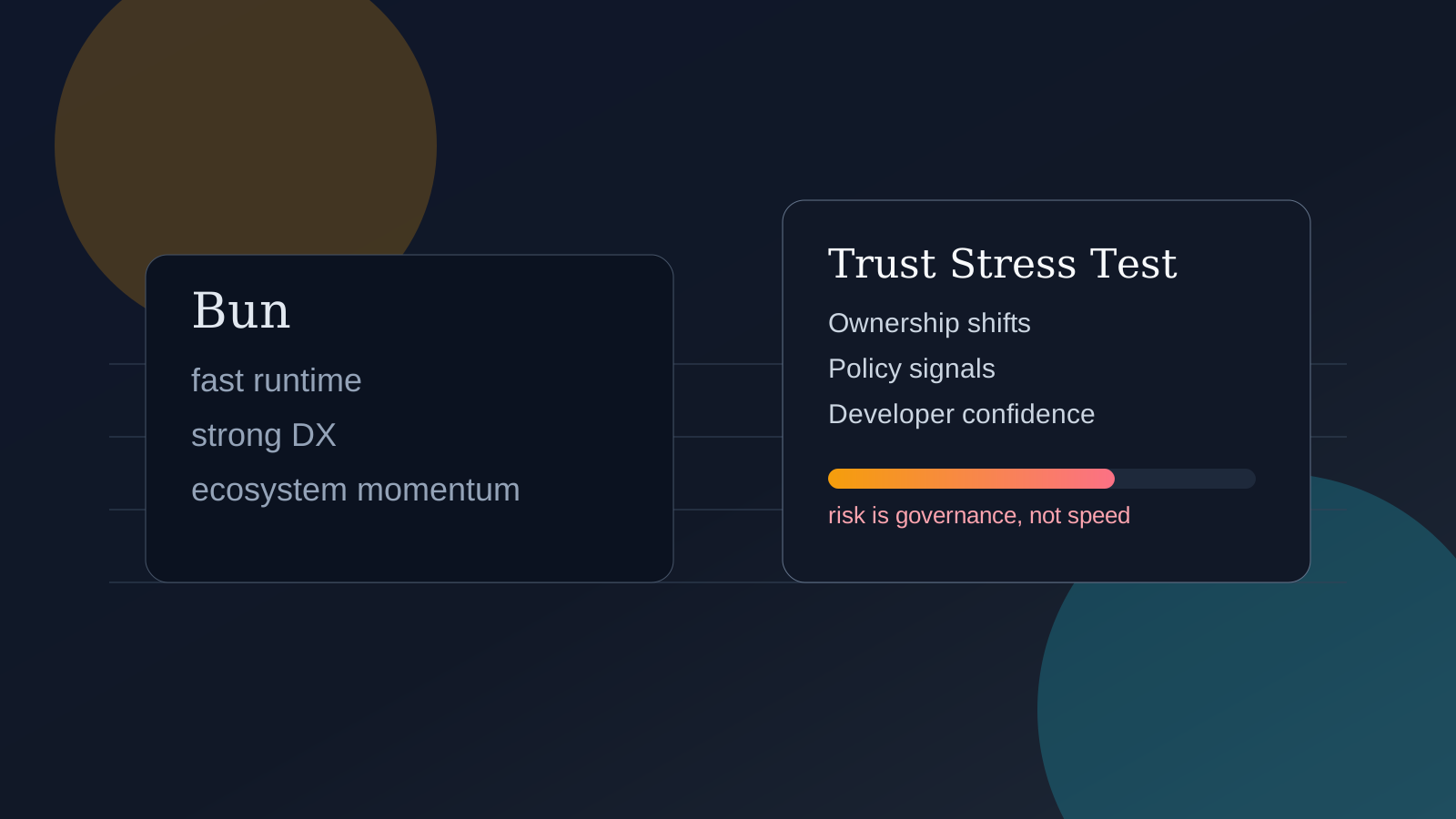
This is not a panic thesis. It is a governance thesis.
Why This Concern Exists At All
That framing mirrors how engineering teams evaluate critical dependencies in real life:
- Is the tool good right now?
- Is the maintainer model stable?
- Are incentives aligned with reliability over years, not quarters?
When Bun was independent, those questions were mostly about technical velocity and ecosystem maturity. After acquisition, they become organizational questions too.
The Acquisition Changed the Risk Surface
In December 2025, Anthropic announced it acquired Bun and positioned the move as strategic infrastructure for Claude Code. Public messaging emphasized continuity: open source license stays, team continuity, and focus on high-performance JavaScript tooling.
On paper, that sounds like good news for developers. A well-funded parent plus a strong existing team can accelerate roadmap delivery.
But acquisitions change one thing immediately even before code changes: decision authority.
The “who decides” layer now includes broader product and business constraints that may not map cleanly to what JavaScript developers want from core tooling.
That does not guarantee decline. It does mean trust has to be re-earned under a new operating model.
Why Claude Code Became Part of the Bun Conversation
The post’s core leap is not technical coupling, it is cultural coupling.
Bun is part of Anthropic’s developer platform strategy. If developers observe instability in one part of that strategy, they naturally update their confidence in adjacent parts, including Bun, even if Bun itself remains strong.
This is a classic platform perception effect:
- Product policies in one area influence trust in other areas.
- Communication quality during incidents affects confidence in future promises.
- Unclear billing or behavior changes get interpreted as governance signals, not one-off mistakes.
In April 2026, Anthropic published a public postmortem on Claude Code quality issues, and separate reporting highlighted pricing and restrictions around third-party harness usage. Even with remediation, those events shaped developer sentiment.
From a risk perspective, the concern is not “Bun is broken now.” The concern is “Will Bun remain protected from the same policy churn that affected nearby products?”
The Important Distinction: Runtime Quality vs. Trust Quality
Developers often mix two different debates:
- Runtime quality: performance, compatibility, correctness, tooling UX.
- Trust quality: predictability of ownership, policy stability, and incentives.
Bun can continue winning the first debate while losing confidence on the second if communication and governance signals are weak.
That distinction explains why some teams now split their stack decisions:
- Keep Bun runtime where it already works well.
- Move package management to pnpm for policy insulation.
- Delay deeper lock-in until post-acquisition patterns become clearer.
This is not ideological. It is portfolio management.
Why pnpm Keeps Showing Up as a Fallback
The original post lands on pnpm for practical reasons, and that tracks with what many teams do when uncertainty rises.
pnpm does not replace Bun as a full runtime+toolchain platform. It replaces one high-value surface: dependency installation and workspace management.
That makes migration smaller and reversible:
- lower blast radius than a full runtime switch,
- less rework than replacing the entire toolchain,
- easier to revisit if confidence improves.
For teams under delivery pressure, partial decoupling is often the rational middle path between “do nothing” and “rip everything out.”
How Engineering Leaders Should Evaluate This Situation
If Bun is in your production path today, a binary “trust / don’t trust” answer is not useful.
Use an explicit review checklist instead:
- Map where Bun is critical in your pipeline: install, test, build, runtime, CI images.
- Separate short-term technical risk from medium-term governance risk.
- Define fallback plans for each surface area before you need them.
- Track upstream communication quality, not just release velocity.
- Re-evaluate quarterly using real incident data, not social media heat.
This avoids both complacency and overreaction.
What Could Rebuild Confidence Quickly
If Anthropic and the Bun team want to reduce this trust discount, there are straightforward moves:
- publish clear autonomy boundaries for Bun roadmap decisions,
- maintain transparent incident reporting when regressions happen,
- avoid surprise policy interactions that affect developer workflows,
- keep compatibility and ecosystem commitments measurable over time.
Developers do not need perfection. They need predictability.
The Bigger Lesson for Tooling Teams
This moment is bigger than Bun.
As AI companies acquire core developer infrastructure, the industry is relearning an old truth: great tools are not only technical artifacts, they are long-term trust contracts.
Performance wins adoption. Governance wins retention.
Bun still has strong technical momentum. The open question is whether the surrounding product governance will strengthen or dilute that momentum over the next year.
That is what this debate is really about.