Claude Design: Anthropic Labs' First Step Into Visual Collaboration
On April 17, 2026, Anthropic introduced Claude Design, the first product shipping out of Anthropic Labs. It’s a research preview aimed squarely at the messy middle of product work—the space between “I have an idea” and “I have something a designer or engineer can actually build.” Claude Design turns prompts, documents, and screenshots into interactive prototypes, pitch decks, wireframes, and one-pagers, all while staying on your brand.
Under the hood it runs on Claude Opus 4.7, and it’s available today at claude.ai/design for Pro, Max, Team, and Enterprise subscribers.
Why “Anthropic Labs”
The launch is notable for more than the product. Anthropic Labs is Anthropic’s new home for applied, vertical products that go beyond a general-purpose chat interface. Claude Code was the first hint of this direction; Claude Design is the first product to explicitly carry the Labs name. Expect the pattern to continue: take a workflow that’s painful today, wrap it around a frontier model, and ship it as a focused surface instead of more features bolted into the chat sidebar.
What Claude Design actually does
Design systems from your own codebase
The single most interesting feature is the way Claude Design bootstraps a design system from your existing work. Point it at a repo, a few screenshots, or brand files, and it extracts the colors, typography, spacing, and components you already use—then applies them consistently to every artifact it generates.
For teams that have spent years trying to keep generated mockups from looking like generic Material Design, this is the part that matters. On-brand by default is a much stronger position than “on-brand if you remember to paste the style guide into every prompt.”
Start from anything
Claude Design accepts a wide range of inputs so you don’t have to translate your source material into a prompt:
- Text prompts for pure greenfield work
- Documents: DOCX, PPTX, XLSX uploads
- Website captures to clone or remix existing UI
- Screenshots and images for visual references
In practice, this means you can drop a PRD, a spreadsheet of features, and a screenshot of a competitor, and ask Claude to produce a first-draft pitch deck that stitches all three together.
Refinement that respects designers
The refinement surface looks less like a chat box and more like a real design tool:
- Inline comments on specific elements
- Direct text editing without re-prompting
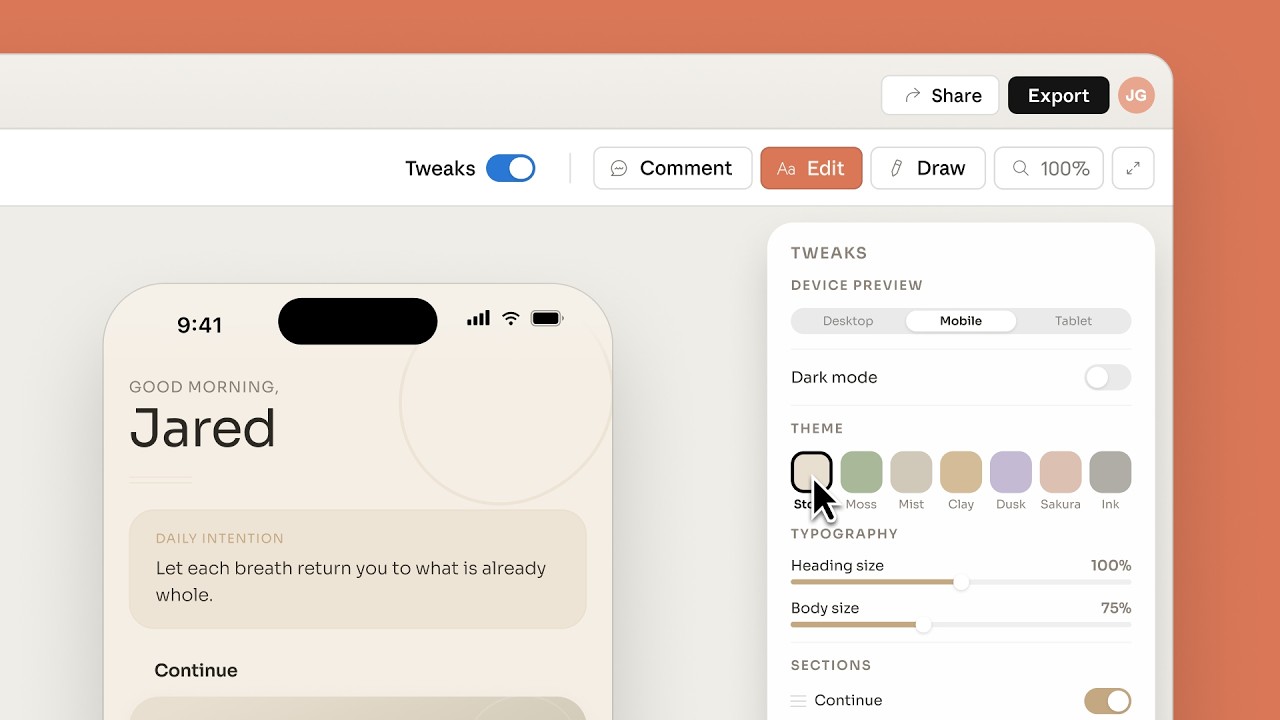
- Sliders for spacing, color, and layout tweaks
You still have a model sitting behind the canvas, but you’re not forced to negotiate every pixel through natural language. That’s the right call—once a layout is 80% there, you want a knob, not a conversation.
Collaboration and export
Sharing is scoped to your organization with the usual private, view-only, and edit permissions. When you’re ready to move the work somewhere else, Claude Design exports into the tools that teams actually use:
- Internal share URLs
- Folder-style saves
- Canva, PDF, PPTX, HTML
And then the Claude Code handoff.
The Claude Code handoff
This is the part that closes the loop. Claude Design can package a design into a bundle—assets, tokens, component structure—that Claude Code can pick up and implement. Design-to-code handoff has been one of the longest-running unsolved problems in product teams, usually because the design tool and the codebase don’t share a vocabulary. When the same model family generated the design system from the codebase, that gap is smaller by construction.
What partners are saying
Anthropic’s launch post leans on three partner quotes that each highlight a different angle:
- Canva’s CEO: “bringing Canva to wherever ideas begin”—a nod to the export-to-Canva integration and the idea that Claude Design sits upstream of existing design tools rather than replacing them.
- Brilliant’s designer: complex pages that took 20+ prompts in other tools needed only 2 in Claude Design. That’s the design-system-first architecture paying off.
- Datadog’s PM: “rough idea to a working prototype before anyone leaves the room.” The use case isn’t replacing designers; it’s compressing the time between a meeting and something concrete enough to argue about.
Where Claude Design fits
Think of Claude Design as the “first artifact” layer of product work. Not the final Figma file, not the production UI, but the thing that unblocks a conversation:
- Interactive prototypes to pressure-test an idea
- Product wireframes before committing engineering time
- Pitch decks that actually match your brand
- Marketing one-pagers
- Code-powered prototypes with voice, video, and 3D elements
The boundary with Claude Code is clean: Claude Design is for exploring and aligning, Claude Code is for building. The handoff between them is the real product.
How to try it
- Go to claude.ai/design
- Sign in with a Pro, Max, Team, or Enterprise account
- Start from a prompt, upload a document, or capture a site
- Point Claude at your brand files or codebase to seed the design system
- Iterate with inline comments and sliders
- Export to Canva, PDF, PPTX, HTML—or hand the bundle to Claude Code
Because it’s a research preview, expect the surface to evolve quickly. The interesting question isn’t whether the current feature set is complete (it isn’t), but whether the architecture—design systems extracted from your own work, frontier-model generation, Claude Code handoff—holds up as teams stress-test it on real projects.
The bigger picture
Every vendor with a frontier model is circling the same insight: the chat box is not the final form factor for most work. Claude Design is Anthropic’s bet that visual collaboration deserves its own surface, the same way coding got Claude Code. If Anthropic Labs keeps shipping at this cadence, the shape of Anthropic’s product line over the next year will look less like “one Claude that does everything” and more like “a handful of focused Claudes that each do one thing extraordinarily well.”
That’s a more interesting bet than another round of model benchmarks.
Learn more
- Official announcement: anthropic.com/news/claude-design-anthropic-labs
- Try it: claude.ai/design
- Claude Opus 4.7: anthropic.com/news/claude-opus-4-7