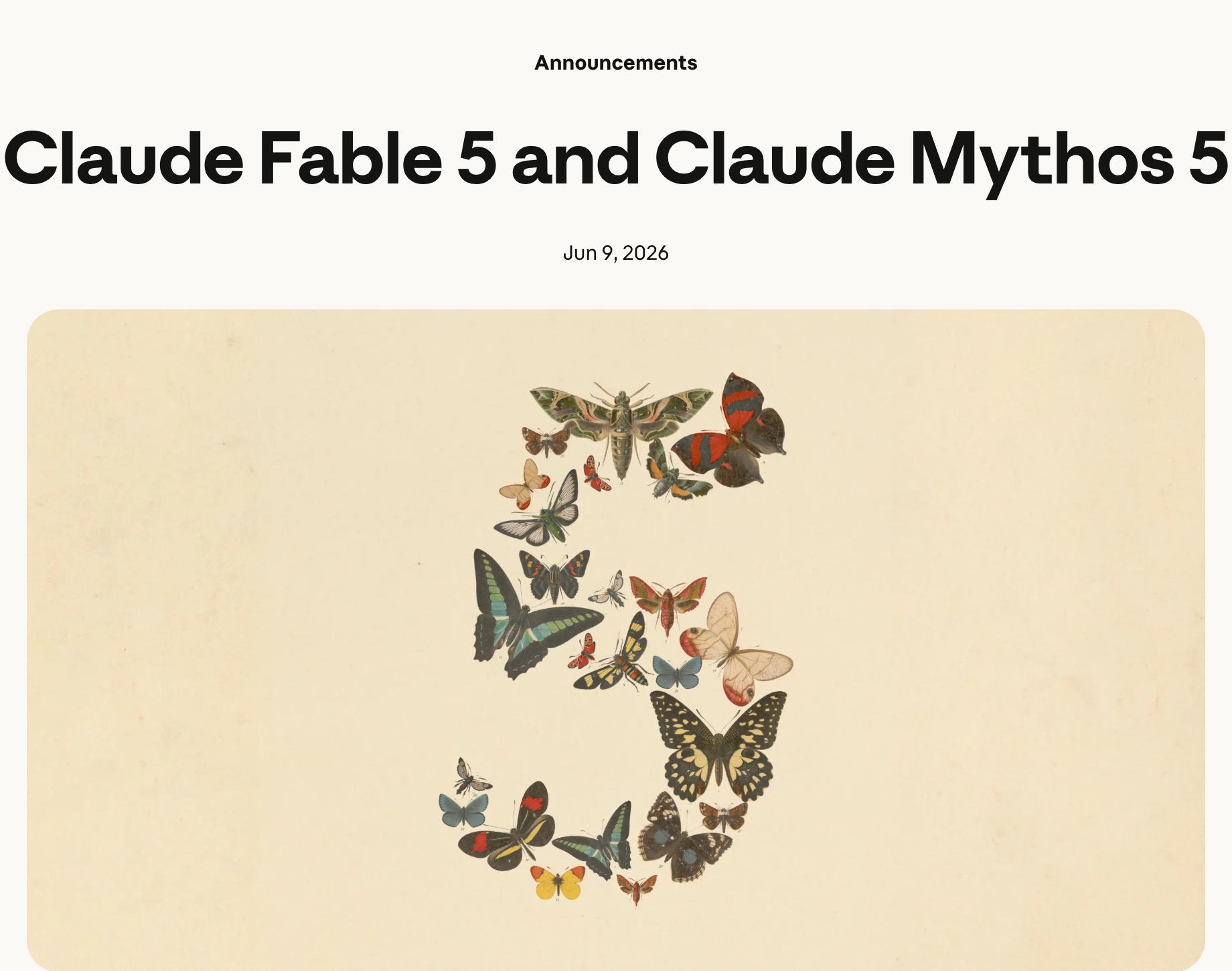
Claude Fable 5 and Mythos 5: Anthropic's New Split Between General Release and Restricted Power
Anthropic has released Claude Fable 5 and Claude Mythos 5, and the launch is more interesting than a normal model refresh. Fable 5 is the broadly available flagship. Mythos 5 shares the same capability profile, but removes the Fable 5 safety classifier layer and is only available to approved customers through Project Glasswing.
That split is the story. Anthropic is not just launching a stronger model. It is drawing a sharper product boundary between the model most developers can use today and a restricted version for customers with special access, governance, and account-team approval.
Both models became available on June 9, 2026. The API model IDs are straightforward:
claude-fable-5claude-mythos-5
What Fable 5 is for
Anthropic describes Claude Fable 5 as its most capable widely released model, aimed at demanding reasoning and long-horizon agentic work. In practical terms, that means the same workloads that have defined the frontier model race for the last year:
- Multi-step coding agents
- Large codebase analysis
- Long technical research sessions
- Tool-heavy workflows
- Planning tasks where errors compound over many steps
- Professional analysis where shallow answers are not enough
The headline specs support that positioning. Fable 5 and Mythos 5 both support a 1M token context window by default and up to 128K output tokens per request. Pricing is $10 per million input tokens and $50 per million output tokens.
That makes Fable 5 more expensive than the recent Opus pricing tier, but also positioned above it. Anthropic is clearly treating this as a premium model for harder tasks, not as a daily default for every prompt.
Why Mythos 5 is different
Claude Mythos 5 is not a normal public model tier. Anthropic says it shares Fable 5’s capabilities, but without the safety classifiers that can decline certain requests. Access is limited through Project Glasswing, and customers need to work through their Anthropic, AWS, or Google Cloud account teams.
That creates a three-part product message:
- Fable 5 is the generally available model for most developers.
- Mythos 5 is the restricted-access model for approved customers.
- Customers without Mythos 5 access are expected to use Fable 5 as the generally available Mythos-class option.
The wording matters. Mythos 5 is not presented as a better model in the usual benchmark sense. It is presented as the same capability package with a different safety and access posture.
Refusals are now an integration concern
One important API detail: Claude Fable 5 can refuse requests through safety classifiers, but those refusals are returned as successful HTTP responses. The Messages API returns stop_reason: "refusal" with HTTP 200, not an error.
That means production integrations should treat refusals as a first-class response path. If your app only checks HTTP status codes, it may silently mishandle refused requests.
Anthropic’s recommended pattern is fallback. A refused Fable 5 request can usually be retried on another Claude model. Developers can use the fallbacks parameter for server-side retry where supported, or SDK middleware in TypeScript, Python, Go, Java, and C# for client-side fallback.
There is also a billing detail worth noticing: Anthropic says refused requests are not billed if they are declined before output generation. When retrying on another model, fallback credit can refund the prompt-cache cost of switching.
Adaptive thinking is always on
Fable 5 and Mythos 5 change how thinking works in the Messages API. Adaptive thinking is the only supported thinking mode. If the thinking parameter is unset, adaptive thinking still applies. Passing thinking: {"type": "disabled"} is not supported.
Instead of turning thinking on or off, developers use the effort parameter to control reasoning depth.
This is a healthier abstraction for agentic workloads. For simple tasks, low effort can keep latency and cost down. For harder work, higher effort gives the model more room to reason. The important part is that the control moves from “should the model think?” to “how much effort should this task deserve?”
Raw thinking is gone
Anthropic is also tightening what gets returned from reasoning models. Raw chain-of-thought content is never returned on Claude Fable 5 or Claude Mythos 5.
By default, thinking.display is "omitted", which returns thinking blocks with an empty thinking field. If developers want a readable version, they can set the display mode to "summarized" and receive summarized thinking instead.
For multi-turn conversations on the same model, Anthropic says thinking blocks should be passed back unchanged. That is the kind of small harness detail that matters when you are building durable agent systems instead of one-off chat demos.
Supported launch features
At launch, Fable 5 and Mythos 5 support the platform features you would expect from Anthropic’s top-end model line:
- Effort controls
- Task budgets, behind the
task-budgets-2026-03-13beta header - The memory tool
- Tool result clearing through context editing, behind the
context-management-2025-06-27beta header - Compaction
- Vision
The combination is important. A 1M context window is useful, but not enough by itself. Long-running agents also need budget controls, memory, compaction, and context management so they can keep working without dragging every old tool result forever.
Availability and data retention
Fable 5 is generally available through the Claude API, Claude Platform on AWS, Amazon Bedrock, Vertex AI, and Microsoft Foundry.
Mythos 5 is not generally available. It is limited to approved customers through Project Glasswing.
Both models are designated Covered Models. Anthropic says they carry 30-day data retention and are not available under zero data retention. That will matter for teams with strict data handling requirements. Before treating either model as a drop-in upgrade, enterprise users should check whether their existing retention assumptions still hold.
How I would evaluate the upgrade
For most teams, the practical upgrade path starts with Fable 5. I would test it against the workflows where model quality has the highest leverage:
- Long code reviews across many files
- Agentic coding tasks that run for more than a few steps
- Architecture analysis with large context
- Research synthesis with many source documents
- Tool-heavy workflows where earlier Claude models lost the thread
- Tasks where the model needs to produce long, structured output
I would also test refusal handling before putting it into production. Because refusals are HTTP 200 responses, they need explicit app behavior: user messaging, fallback routing, logging, and billing expectations.
For Mythos 5, the question is less technical and more operational. If you are not already in the kind of environment where Project Glasswing access makes sense, Fable 5 is the model to evaluate.
The bigger picture
Claude Fable 5 looks like Anthropic’s new public ceiling: expensive, long-context, agent-oriented, and built for professional workloads where better reasoning can justify the price.
Claude Mythos 5 is a different signal. It shows Anthropic creating a restricted channel for customers who need the same model capability under a different safety-classifier setup. That is a major product distinction, and it may become more common as frontier labs try to serve both broad developer markets and tightly governed enterprise or research deployments.
For developers, the immediate takeaway is simple: Fable 5 is the model to test if your current bottleneck is reasoning depth, long context, or sustained agent work. But treat it like a new platform behavior, not just a new model ID. Refusals, fallback, adaptive thinking, summarized thinking, and data retention all need to be part of the integration plan.
Learn More
- Anthropic documentation: Introducing Claude Fable 5 and Claude Mythos 5
- Models overview: Claude models overview
- Project Glasswing: anthropic.com/project/glasswing