Claude Sonnet 5.5: Near-Opus Results at Half the Token Price
Anthropic released Claude Sonnet 5.5 on September 28, 2026. It is the second model in the Claude 5.5 family, six days after Claude Opus 5.5.
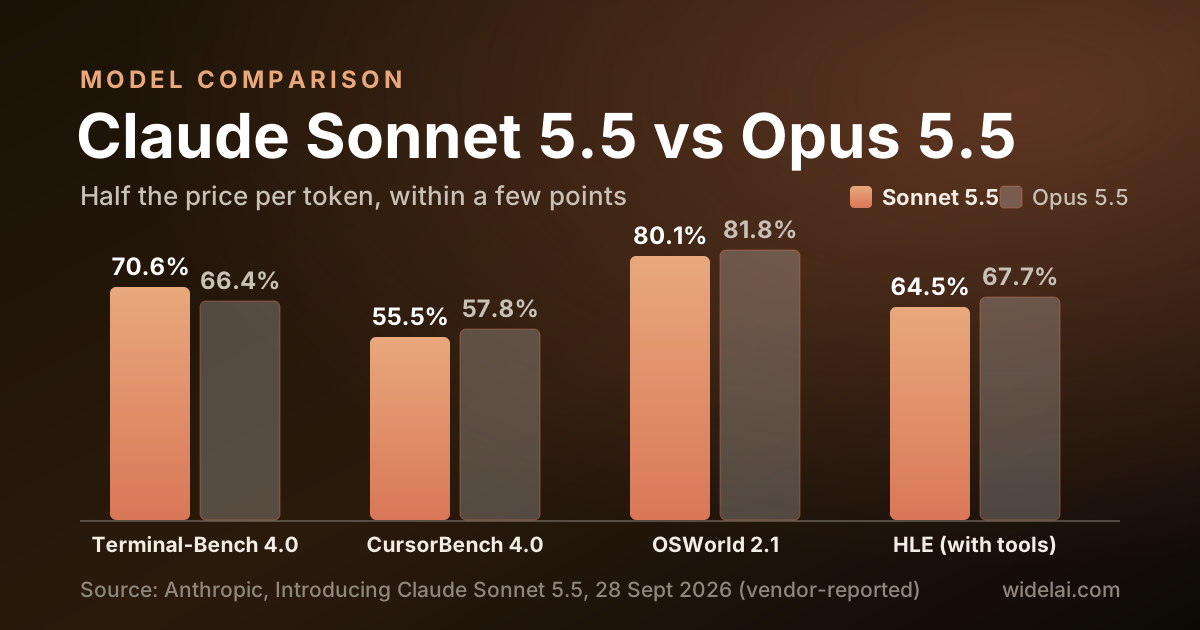
The headline is simple: on most of Anthropic’s published benchmarks, Sonnet 5.5 lands within a few points of Opus 5.5, while costing half as much per input and output token. It also generates output more than 30% faster than Claude Sonnet 5 and, according to Anthropic, costs up to 30% less per task because it needs fewer tokens to finish the same work.
That makes Sonnet 5.5 less of a “cheaper fallback” and more of a real default. The question for most teams is no longer “is Sonnet good enough?” but “which work still needs Opus?”
The short version
- Big jump over Sonnet 5 in coding, knowledge work, computer use, and chart reading
- Close to Opus 5.5 on most benchmarks, sometimes within one or two points
- Half the token price of Opus 5.5 for input, output, and cache writes
- 30%+ faster output than Sonnet 5, and fewer tokens per task
- First Sonnet model with cyber safeguards, which visibly fall back to Sonnet 5 for high-risk security requests
- One migration change if you run Sonnet with thinking turned off
Anthropic is also clear about the limit: Opus 5.5 “remains clearly stronger at complex, open-ended work requiring sustained judgment.” Sonnet 5.5 is built for well-scoped everyday work: fixing bugs, iterating fast, and producing documents, slides, and spreadsheets.
Where Sonnet 5.5 fits
The Claude 5.5 family now looks like this:
- Opus 5.5 — complex work that needs careful judgment over long sessions
- Sonnet 5.5 — well-scoped everyday tasks, fast iteration, polished documents and UI
- Haiku 5.5 — high-volume, cost-sensitive work, arriving in the coming weeks
The split is not really about intelligence tiers anymore. On many tasks, the two larger models score about the same. The split is about how much open-ended judgment a task needs and how much you want to spend per attempt.
The benchmark picture
These are Anthropic’s reported results:
| Evaluation | Sonnet 5.5 | Sonnet 5 | Opus 5.5 | GPT-6 Sol |
|---|---|---|---|---|
| Terminal-Bench 4.0 | 70.6% | 10.3% | 66.4% | — |
| FrontierCode 1.1 (Main) | 52.1% (Xhigh) / 46.2% (Max) | 42.4% | 54.4% | 49.3% |
| CursorBench 4.0 | 55.5% | 34.1% | 57.8% | — |
| GDPval-AA v2.1 | 1844 | 1449 | 1846 | 1487 |
| AA-Briefcase v1.1 | 1811 | 1359 | 1822 | 1483 |
| Humanity’s Last Exam (tools) | 64.5% | 54.9% | 67.7% | — |
| OSWorld 2.1 | 80.1% | 57.0% | 81.8% | — |
| Chartography (no tools) | 61.6% | 15.6% | 64.4% | 53.6% |
A few details matter more than the headline numbers:
- Terminal-Bench is the one place Sonnet 5.5 beats Opus 5.5, but read it carefully. Anthropic’s footnote says the Opus 5.5 score is at Xhigh effort, its best result. The jump from Sonnet 5’s 10.3% is so large that it deserves independent confirmation.
- FrontierCode is lower at Max effort than at Xhigh. At Max, Sonnet 5.5 more often ran Claude Code’s multi-agent code-review skill. That sometimes caused timeouts or extra edits outside the task’s scope, which this benchmark penalizes. More effort is not always better.
- The knowledge-work numbers come with caveats. Artificial Analysis ran GDPval-AA and AA-Briefcase on a pre-release build that had a structured-output bug (since fixed). The GPT-6 Sol scores may also predate an OpenAI fix for image understanding.
- GDPval-AA is nearly a tie. Sonnet 5.5 scores 1844 against Opus 5.5’s 1846, and about 400 points above Sonnet 5.
The pattern is consistent: Sonnet 5.5 closes most of the gap to Opus 5.5 and pulls far ahead of Sonnet 5. The biggest jumps are in chart reading (+46 points), terminal coding, and computer use (+23 points on OSWorld 2.1).
Price per token vs. cost per task
Anthropic says Sonnet 5.5 is priced the same as Sonnet 5. Against Opus 5.5, the comparison is clean:
| Price per 1M tokens | Sonnet 5.5 | Opus 5.5 | Difference |
|---|---|---|---|
| Input | $2 | $4 | half |
| Output | $10 | $20 | half |
| Cache writes | $2.50 | $5 | half |
| Cache reads | $0.20 | $0.20 | same |
The more useful number is cost per task, which depends on how many tokens and steps the model uses. Anthropic’s cost charts make a few strong claims:
- On several benchmarks, Sonnet 5.5 at Low or Medium effort beats Sonnet 5’s best score for about a tenth of the cost per task.
- On FrontierCode at High effort, it scores 10 points higher than Sonnet 5 at the same setting, for about one fifteenth of the cost.
- At High effort, it matches GPT-6 Sol’s best FrontierCode score for about a fifth of the cost.
Anthropic also notes that Sonnet 5.5 complements Opus 5.5 best at lower effort settings. At the highest settings, the two models can reach similar scores at a similar cost. In other words, the savings come from running Sonnet 5.5 at Low or Medium effort on work that does not need more, not from running it at Max effort on everything.
What early testers noticed: fewer tokens, fewer steps
Launch quotes are chosen by the vendor, so treat them as signals, not proof. Still, the same theme shows up across most of them: Sonnet 5.5 reaches a result with less work.
- Balyasny Asset Management: about 121k tokens per answer on 2,441 finance tasks, compared with 497k for Sonnet 5, with higher scores
- Base44: across 118 real app builds, 3.6 iterations per build on average, compared with 7.7 for Opus 5, with similar app quality
- Lovable: a third fewer tool calls and roughly half the shell runs to finish a coding task
- Slack: better results on almost all offline Slackbot evals, with about 14% fewer output tokens and no prompt changes
- Box: 2.4x faster and 12% fewer total tokens, while catching data errors Sonnet 5 missed
- Zendesk: tickets processed 20% faster, with fewer wrong decisions
- CodeRabbit: Sonnet 5’s habit of reaching for web search too often is gone
Anthropic’s own explanation matches this: in head-to-head runs, Sonnet 5.5 batched tool calls together more often than Sonnet 5. For agents, fewer steps means less waiting, lower cost, and fewer chances to drift.
Knowledge work, design, and long tasks
Sonnet 5.5 is also pitched as a better partner for documents and design work. Anthropic says testers noticed it adds polish to user interfaces and can follow slide templates closely enough that decks need little editing.
In one internal test, Anthropic gave it a public company’s earnings materials, call transcripts, and a slide template, and asked for a 10-slide operating review. Two experts judged the first draft ready to send as is.
It is also stronger on long-horizon work and image understanding. It is the first Sonnet model to beat Pokémon Red using only screenshots. That is a playful test, but it checks something real: staying on track over a very long task using only visual input.
Safety and safeguards
Anthropic says Sonnet 5.5 does not push the frontier of its models’ capabilities, so the alignment review focused on risks that apply at any level: acting against users, misleading them, and helping with high-stakes misuse.
The reported results:
- On an automated behavioral audit of about 1,850 scenarios, Sonnet 5.5 matches or improves on Sonnet 5 on most measures
- On containment tests, it comes close to Opus 5.5 in how rarely it tries to escape its sandbox, and is the least likely of any Claude model to probe container limits
- Opus 5.5 still scores slightly better overall
- Anthropic found no evidence that Sonnet 5.5 pursues goals that conflict with the user’s intention, while admitting that no set of evaluations catches every failure
The safeguards matter more for day-to-day use:
- Cybersecurity: Sonnet 5.5’s cyber skills are a big step up from Sonnet 5, so it is the first Sonnet model with Opus-style cyber safeguards. Routine bug finding and fixing still work. Higher-risk security tasks visibly fall back to Sonnet 5. An expanded Cyber Verification Program is coming for defenders.
- Biology: Same safeguards as Sonnet 5. Some microbiology and virology requests may be flagged in error.
- Distillation: New classifiers block attempts to extract its reasoning at scale.
If you build security tooling on Sonnet, test these paths directly. The model you think you are calling may not be the model that answers.
Migration notes for developers
The upgrade is mostly a model ID change, with a few details to check:
- Model ID:
claude-sonnet-5-5, available on the Claude Platform, AWS, Google Cloud, and Microsoft Azure. - Thinking off: If you run Sonnet with thinking disabled, you need to switch to the new
between_toolssetting before moving to Sonnet 5.5. It keeps up-front thinking off. See the migration guide. - Effort defaults: Medium in Claude Code and the Claude apps, High on the Claude Platform. Given the cost curves above, try Medium or Low for routine work before accepting the default.
- Preserved thinking: Claude’s thinking can no longer be separated from the account that created it. Most developers will not notice. If you move conversations between accounts, including switching accounts mid-session in Claude Code, read the docs first.
- Data retention: Zero data retention is available, as with Opus 5.5 and Sonnet 5.
Sonnet 5.5 or Opus 5.5?
A simple starting rule:
- Start with Sonnet 5.5 for bug fixes, well-defined features, code review, support flows, document and slide generation, and high-volume agent steps
- Escalate to Opus 5.5 for architecture decisions, ambiguous multi-week projects, large migrations, and work where one wrong judgment is expensive
- Pair them for larger jobs: Opus plans and sets the structure, Sonnet implements
One early tester described that last pattern directly: when Opus 5.5 sets the architecture for a game, they would be confident letting Sonnet 5.5 implement it.
How I would evaluate Sonnet 5.5
Do not rely on a single prompt. Compare it against both the model you use today and Opus 5.5:
- Pick 10 to 20 real tasks from your backlog: bug fixes, small features, reviews, and reports.
- Run each task on Sonnet 5, Sonnet 5.5 (Low, Medium, High), and Opus 5.5.
- Measure success rate, total tokens, tool calls, elapsed time, and human corrections.
- Check whether Sonnet 5.5 at Medium matches Sonnet 5 at its best, as Anthropic claims.
- Find the tasks where Sonnet 5.5 fails and Opus 5.5 succeeds. Those define your routing rule.
- If you run with thinking off, test the
between_toolsmigration before switching production traffic. - If you handle security work, send legitimate security requests and confirm how fallbacks appear to users.
The goal is not to find the smartest model. It is to find the cheapest model that reliably finishes each type of work.
The practical takeaway
Claude Sonnet 5.5 narrows the gap between “good enough” and “best available” to a few benchmark points, at half the token price of Opus 5.5 and with noticeably fewer tokens per task than Sonnet 5.
The claims are vendor-reported and still need independent testing, especially the large Terminal-Bench jump and the long-running agent results. But the direction is clear. For most everyday engineering and knowledge work, Sonnet 5.5 is positioned as the default, with Opus 5.5 kept for the work that truly needs sustained judgment.
For teams paying Opus prices on routine work, that is a strong reason to re-run the routing math this week.