
What CPython's Official RISC-V Support Actually Guarantees
Python could run on RISC-V before August 2026. Linux distributions shipped it, developers built it, and architecture-specific patches had been landing for years. What changed when CPython called RISC-V “officially supported” was not the sudden appearance of a working interpreter. The change was a maintenance contract.
The riscv64-unknown-linux-gnu target now appears in PEP 11 as a Tier 3 platform for both GCC and Clang with glibc. It has reliable buildbots and named maintainers. That means the core project continuously checks the platform and has people who have agreed to look after it. It does not yet mean that every regression blocks a merge or a Python release.
That distinction is the useful story. Architecture support in a large runtime is not a Boolean. It is a chain running from instruction-set definitions through compilers, operating systems, interpreter internals, continuous testing, binary packaging, and real applications. CPython has now made one important link durable. The rest of the Python ecosystem still has work to do.
“It builds” is not the same as “we support it”
A portable C program often reaches a new architecture surprisingly early. A compiler can translate most of the code, the operating system supplies familiar POSIX interfaces, and a developer can patch the handful of assumptions that fail. That produces a successful build. It does not ensure the next change to garbage collection, atomics, stack unwinding, libffi, profiling, or the experimental JIT will preserve that success.
PEP 11 exists because dormant platform code becomes a liability. Without machines that run the test suite and maintainers who understand the failures, the main branch can drift until the port is broken. Nobody knows whether an old conditional is still required, and ordinary refactoring may accidentally depend on x86-64 or AArch64 behavior.
Tiered support replaces the vague claim “Python runs here” with explicit obligations.
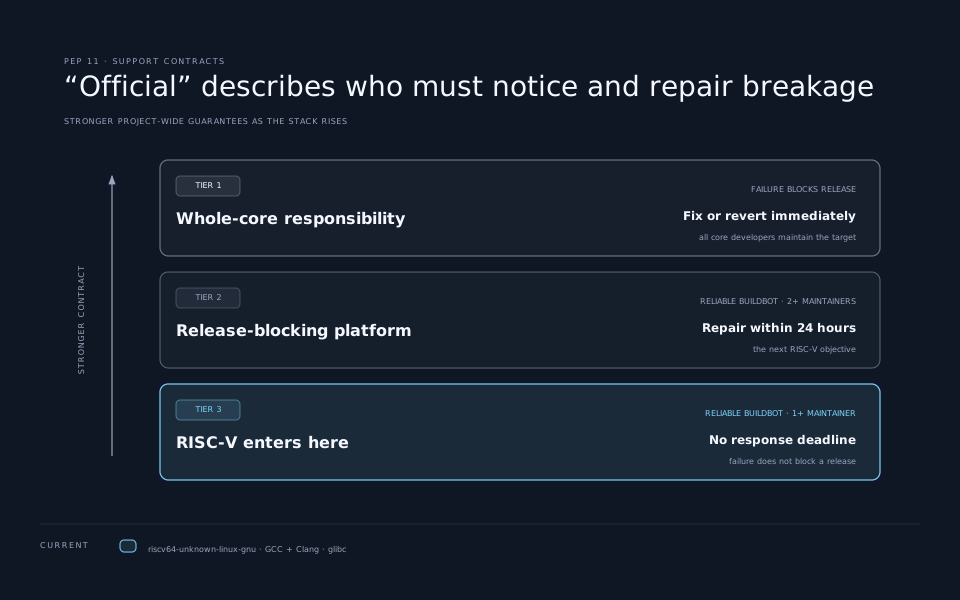
At Tier 3, a platform needs a reliable buildbot and at least one core developer as a contact. Failures do not block releases, and PEP 11 specifies no response deadline. This is where 64-bit RISC-V now sits, with Stan Ulbrych and Emma Smith listed for the GCC and Clang configurations.
At Tier 2, a platform still needs reliable automation but must have at least two core maintainers. A break must be fixed or reverted within 24 hours, and a failing platform blocks a release. AArch64 Linux with Clang, Windows on ARM64, WASI, x86-64 macOS, and x86-64 Linux with Clang currently occupy this tier.
At Tier 1, failures block releases and breaking changes may not remain on main. Responsibility belongs to all core developers, not only named platform specialists. The list covers the dominant release environments, including x86-64 Linux with GCC, AArch64 Linux with GCC, macOS on Apple silicon, and the principal Windows targets.
The tiers are not a score of processor quality. They describe how much project-wide disruption CPython is willing to accept to preserve a target. RISC-V entering Tier 3 means the port is no longer merely tolerated platform code. It has a documented place in CPython’s development process.
Why real RISC-V machines changed the equation
The decisive resource was not one more portability patch. It was dependable hardware.
The Python announcement credits the RISE Project with providing several RISC-V machines for buildbots and architecture-specific debugging. Those systems repeatedly build the current branch and run CPython’s test suite after changes land. A regression that would otherwise wait for a user report becomes visible to maintainers.
Cross-compilation cannot provide the same feedback. It proves that a compiler can emit a binary for another target; it does not naturally execute the full suite on that target. Emulation is excellent for bootstrapping and broad test matrices, but it can hide timing behavior, differ around kernel and hardware features, and make an already large test suite much slower. Native machines expose the software stack that users actually run.
RISC-V makes this especially important because it is a family of implementations, not a single chip. The unprivileged ISA specification defines a small base instruction set plus optional extensions. RV64I supplies the 64-bit integer base; common systems add multiplication and division, atomics, floating point, compressed instructions, vectors, and other extensions. Implementations can differ in microarchitecture and available extensions while presenting the same broad architecture name.
A runtime can be perfectly ordinary C at its center and still touch machine-specific seams:
- Atomic operations and memory-ordering assumptions become critical in a free-threaded interpreter.
- Stack walking, signal handling, and profilers depend on calling conventions and register definitions.
ctypesand extension modules depend on ABI details and foreign-function libraries.- Dynamic code generation needs a machine-code backend, instruction-cache synchronization, and unwind metadata.
- Compiler optimizations can expose alignment or undefined-behavior bugs that another architecture never revealed.
- Tests involving timeouts or concurrency can behave differently on slower cores.
One historical example is CPython issue #121138, where enabling Linux perf trampoline support caused a RISC-V build to stop at an explicit “unsupported target architecture” error. The core interpreter was not fundamentally incapable of running. A specialized observability feature had reached an architecture-specific boundary. That is typical porting work: the last few percent lives in debugging, packaging, performance, and operational tools rather than the language evaluator alone.
The feedback loop still starts too late
Buildbots give CPython the evidence required for Tier 3, but their timing matters. They generally test after a patch has merged. If a change breaks RISC-V, the main branch can remain broken until the builder reports the result and someone prepares a repair.
The next infrastructure step is to add RISC-V to pre-merge continuous integration. RISE’s runner service provides ephemeral Ubuntu jobs on native RISC-V hardware. A workflow can select ubuntu-24.04-riscv, compile the proposed revision, run tests, and discard the machine after the job. That gives the author feedback while the patch is still under review.
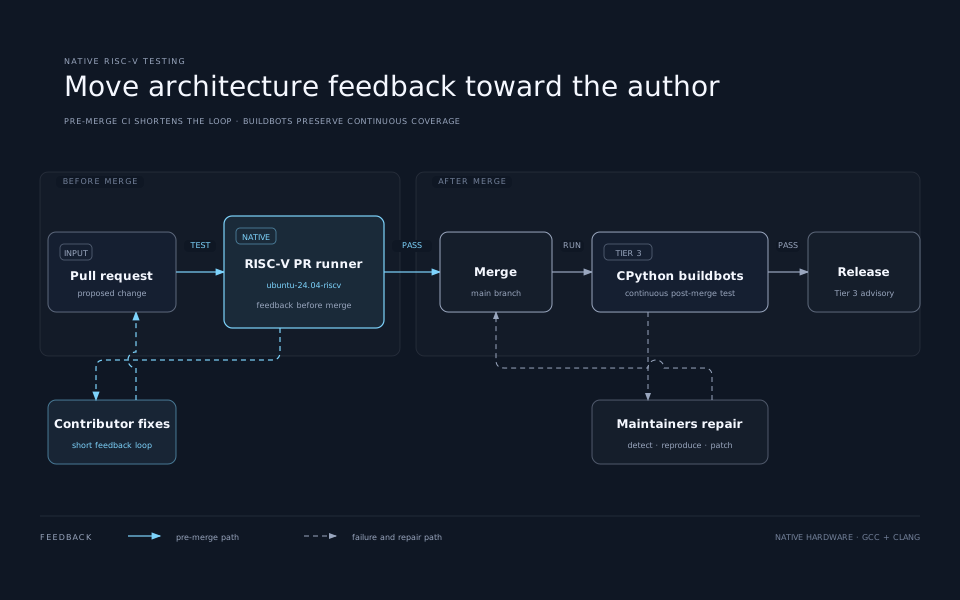
This is more than a speed improvement. Earlier feedback changes who can repair a problem. The author still has the patch in context and can amend it before unrelated changes accumulate. Reviewers can see the platform result beside the existing checks. Maintainers spend less time bisecting a failure that appeared after merge.
The RISE runner documentation describes an environment meant to resemble a standard GitHub Actions Ubuntu runner, with native GCC and Clang, containers, and common language toolchains. It is not a substitute for CPython’s long-lived buildbot fleet. It complements that fleet:
- Pull-request CI protects the merge boundary.
- Buildbots continuously exercise configurations, slow tests, and post-merge state.
- Maintainers investigate architecture-specific failures.
- Release policy determines whether a failure is advisory or blocking.
For Tier 2, all four parts must work reliably enough to support a 24-hour repair expectation and release-blocking status. Hardware availability is necessary, but the social commitment to respond is equally important.
A Python runtime is only the first layer
Installing pure-Python packages on RISC-V is usually uneventful: source files and bytecode are architecture-independent. The friction begins with native extensions.
Packages such as NumPy, cryptography libraries, image codecs, database drivers, and machine-learning frameworks often publish wheels containing compiled code. On a common x86-64 system, pip install downloads a matching wheel in seconds. When a project does not publish a RISC-V wheel, pip falls back to a source build or reports that no compatible distribution exists. The user then needs compilers, headers, system libraries, memory, time, and a build process that already understands the architecture.
The packaging foundation is improving. The manylinux project now lists an alpha manylinux_2_39_riscv64 image and a musllinux_1_2_riscv64 image. Its containers include multiple CPython versions and the tooling needed to produce policy-compliant wheels. cibuildwheel’s platform matrix contains RISC-V CPython build identifiers. The standardized manylinux_x_y_arch scheme lets a wheel declare the minimum glibc generation it expects rather than tying it to one distribution.
Those capabilities make publishing possible; they do not make it automatic. Every package with native code must decide to add the architecture, obtain native or emulated CI capacity, repair its dependencies, and upload artifacts. A scientific application may depend on dozens of compiled packages, so one missing wheel can push the entire installation down the source-build path.
This creates a practical support ladder for users:
- Interpreter: Does CPython build and pass its own tests?
- Packaging tools: Can
pip, wheel tags, audit tools, and build images represent the target? - Foundational libraries: Are compilers, BLAS, OpenSSL, libffi, Rust, and other native dependencies healthy?
- Published wheels: Do maintainers continuously upload RISC-V artifacts?
- Applications: Do real workloads pass their own suites and meet performance expectations?
CPython’s Tier 3 milestone stabilizes the bottom of that ladder. It gives upstream package maintainers a more trustworthy runtime to target and makes failures easier to classify. It cannot promise that a random requirements.txt will install without compilation.
What developers can test today
The highest-value reports come from ordinary workloads, not only from rebuilding CPython.
On a 64-bit RISC-V Linux machine, developers can build the current CPython branch with the usual configure and make flow, run make test, and then exercise real projects. Testing with both GCC and Clang matters because PEP 11 lists separate configurations. So does recording the distribution, kernel, compiler, libc, CPU, and available ISA extensions. “Fails on RISC-V” is far less actionable than a reproducible command with a precise environment.
Package maintainers can add a native runner job without making it release-blocking on day one. Start with a scheduled or allowed-to-fail build, measure its duration and reliability, then promote it once failures are understood. For a C or Rust extension, verify more than import success: run the full suite, build a wheel, inspect its platform tag, install it into a clean environment, and test the installed artifact.
Performance work should follow correctness. RISC-V’s modular extensions create room for architecture-specific optimization, but a baseline binary must remain valid on the systems it claims to support. Dispatching to vector or crypto extensions requires feature detection and a safe fallback. Assuming that every riscv64 machine exposes the same extension set would trade portability for a benchmark win.
The most useful bug reports will cluster around boundaries:
- free-threaded builds and atomics;
- native extension compilation and linking;
- profilers, debuggers, and stack unwinding;
- JIT or executable-memory behavior;
- wheel production and repair;
- numerical libraries and vectorized kernels;
- tests that are sensitive to timing or memory.
Reporting these upstream matters because Tier 3 has no automatic repair deadline. The platform becomes stronger when users supply failures that maintainers can reproduce and convert into regression tests.
What Tier 2 would mean
Promotion would not mean CPython suddenly runs twice as fast on RISC-V. It would mean regressions carry more project-level consequence.
To sustain Tier 2, RISC-V needs reliable builders, at least two core developers committed to the platform, a repair path that works within 24 hours, and enough confidence that failures can block a Python release without creating chronic instability. Pre-merge CI reduces that risk. Broader user testing supplies the unusual configurations that a small builder fleet misses. More maintainers distribute the response burden.
There is a useful precedent in WASI. PEP 11 records it as Tier 3 for Python 3.11 and 3.12, then Tier 2 beginning with Python 3.13. The transition happened because support became a maintained process with dependable tooling and people, not because a single patch flipped a switch.
RISC-V is now at the beginning of the same institutional path. The interpreter runs. The buildbots watch it. Maintainers are named. Native pull-request runners are being explored. Packaging images and wheel tooling exist. Each piece converts individual porting effort into infrastructure that survives the original contributor.
That is what “official support” is worth: not a badge on an architecture list, but a growing set of promises that can be tested.
Further reading
- RISC-V is now officially supported by CPython, the Python core team’s announcement and acknowledgements.
- PEP 11: CPython platform support, the normative tier definitions and current target matrix.
- RISC-V unprivileged ISA introduction, the base-and-extension architecture model.
- RISE RISC-V Runners, native GitHub Actions runner configuration.
- PyPA manylinux, portable Linux wheel policies and RISC-V build images.
- Python platform compatibility tags, how installers match wheels to runtimes and systems.