
Deno Joins Cloudflare: What Ends, What Continues, and Why celld Matters
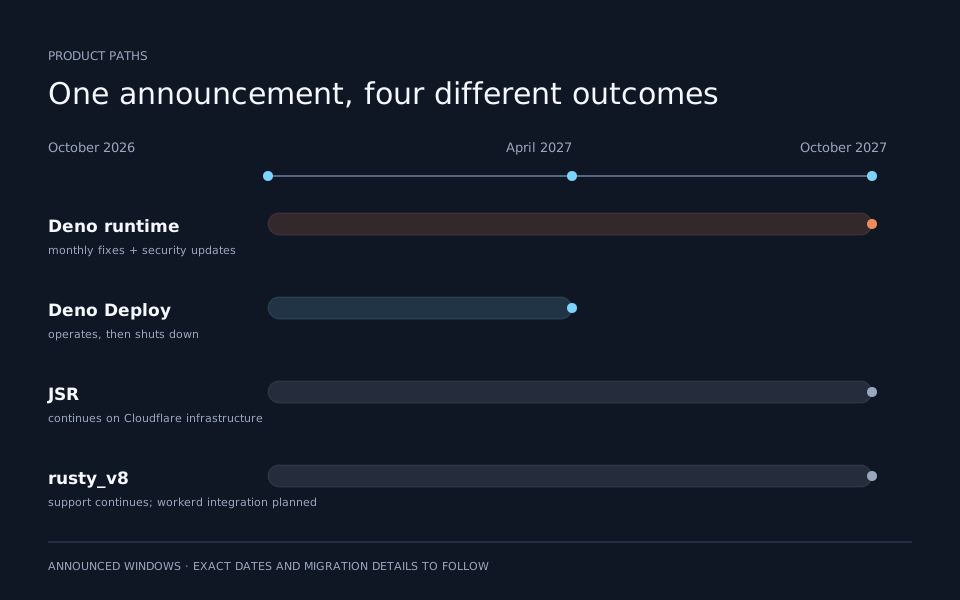
Deno’s team is joining Cloudflare. That sentence sounds like a straightforward acquisition announcement, but it changes the road map for several products that people use in different ways. The Deno runtime will receive a final year of maintenance from its current team. Deno Deploy will shut down after six months. JSR will keep operating. The team’s future work will go into a shared platform built around Cloudflare’s Workers runtime and Durable Objects.
The Deno announcement gives those commitments directly. A joint explanation by Ryan Dahl and Kenton Varda explains the technical reason for the move: combine Deno’s celld project with Cloudflare’s open-source workerd runtime so the Workers programming model can run as a distributed system on infrastructure outside Cloudflare’s network.
These are separate stories for an application owner and a platform engineer. An application owner needs to plan for maintenance and hosting deadlines. A platform engineer should pay attention to the missing layer between an open-source runtime and an operable, distributed service.
The four products do not share one fate
It helps to name the pieces before discussing what changes:
| Project | Its job | Announced direction |
|---|---|---|
| Deno runtime | Execute JavaScript and TypeScript with Deno’s tools and APIs | Monthly bug-fix and security releases for one year, then Deno’s team ends development; source stays open |
| Deno Deploy | Host applications on Deno’s managed platform | Operates for six more months, then shuts down; paying customers can get migration support for Cloudflare Workers |
| JSR | Publish and install JavaScript and TypeScript packages | Continues operating while its infrastructure moves to Cloudflare |
rusty_v8 | Rust bindings used to embed V8 | Continues to receive support, with work toward integration into workerd |
The one-year and six-month windows start from the October 9, 2026 announcement. The announcement does not give an exact shutdown date or a complete migration specification, so treat calendar dates calculated from those windows as planning targets until the companies publish operational details. It also does not promise that Deno programs will run unchanged as Workers. The runtimes expose different execution models and platform APIs.
There is also a naming trap. Deno Deploy Classic was an older generation already scheduled to shut down in July 2026. Deno’s new announcement concerns the current Deno Deploy service. Its earlier Classic migration guide is useful history, but its instructions are not a complete guide for this new move to Workers.
Why the team moved beyond a JavaScript runtime
Deno started by rethinking the local server-side JavaScript experience: module distribution, permissions, TypeScript, built-in tools, standalone executables, and eventually Node.js compatibility. Those capabilities made it easier to write and ship a program. They did not make the surrounding production system disappear. A networked service still needs persistent data, communication between instances, deployment, and a way to scale.
Deno Deploy was the team’s attempt to bring execution and hosting closer together. Operating it exposed another set of dependencies: clouds, databases, and service infrastructure. Dahl’s earlier argument for “JavaScript Containers” framed the longer-running goal as putting compute, storage, and communication into a simpler unit. The acquisition announcement places Deno, Deploy, and celld on that same path rather than presenting them as unrelated experiments.
Cloudflare’s Durable Objects supplied a useful programming unit. A Durable Object is addressed by an ID. It combines single-threaded JavaScript execution with persistent storage and can hold WebSocket connections. The Cloudflare documentation describes how the platform routes requests for a given object to its active instance. For a chat service, one object per room can own that room’s connections and state. Application code gets a clear place to put coordination logic; the platform takes responsibility for placement and routing.
That model does not eliminate distributed-systems work. It relocates much of it from each application into the platform. If thousands of rooms live on different machines, somebody still needs to find the right machine, restore state, move work after failure, and keep storage durable. The key design question is who builds and operates that layer.
The gap between workerd and a self-hosted platform
Cloudflare has already published workerd as open source. It is the Workers runtime, but a runtime alone is not a turnkey replacement for Cloudflare’s distributed service. Varda identifies a specific gap: self-hosted workerd supports Durable Objects on a single instance, while Cloudflare’s own multi-instance routing and storage machinery is tied to its large production environment. A team running workerd on its own servers must still assemble more around it to get distributed Durable Objects.
That is where celld fits. The celld project was designed to run Workers and Durable Objects across machines with a small operational footprint: multiple instances of a Rust binary plus object storage. Dahl describes it as a way to get the application model without rebuilding the many services he encountered while running Deploy. The joint plan is to merge celld’s code and ideas into workerd, led by Dahl and Bert Belder, and make self-hosting a supported path.
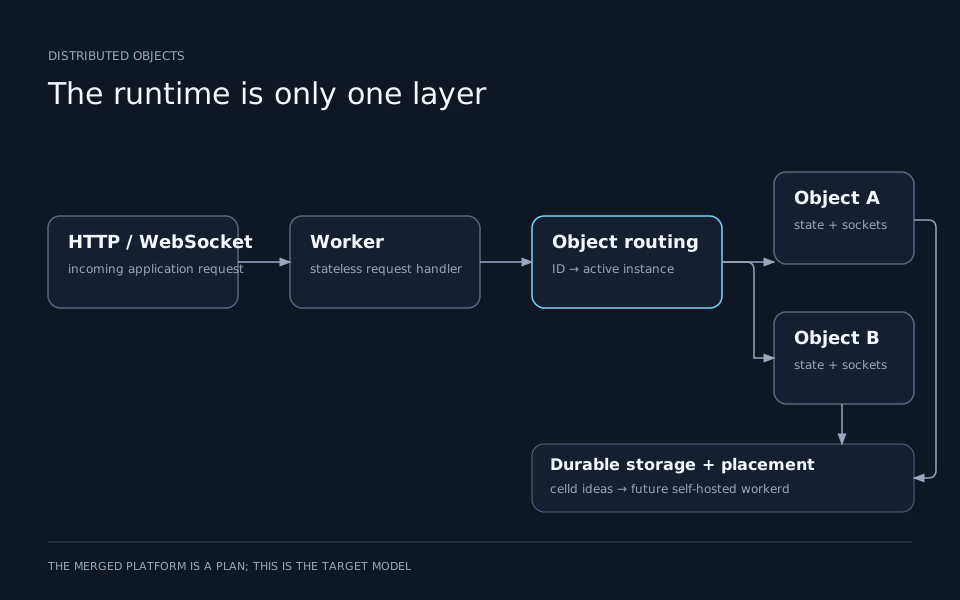
The announced integration is a plan, not a finished product. Cloudflare says developers can run celld or workerd today, and that it will share more about the merged effort later. Those present-day projects do not by themselves prove that every Cloudflare Workers feature is portable, nor that an existing Deno Deploy application can be moved without changes. Compatibility, storage migration, deployment tooling, and operational support need testing against the actual platform as it develops.
What application teams should do now
The right response depends on which Deno product is in use.
If a service runs on Deno Deploy, inventory its entry points, bindings, secrets, domains, cron jobs, data stores, and outbound integrations. Identify which parts use Deno-specific APIs and which use standard web APIs. Build a small Workers proof of concept for the highest-risk feature before moving the whole application. Paying customers should use the migration support Deno has promised, while everyone should watch for a dedicated guide for the current Deploy shutdown. Preserve a rollback route until behavior and data have been checked in production.
If a service runs on the Deno runtime in a container, VM, or local build pipeline, there is no announced forced shutdown of the binary or source repository. There is, however, a maintenance horizon for the current team. Pin releases, keep security updates moving during the support year, list the Deno APIs your project depends on, and decide whether an open-source successor community can support your needs. Moving to Node.js, Bun, or Workers would be a separate engineering decision, not an automatic result of this announcement.
If a library is published to JSR, the stated plan is continuity with infrastructure moving to Cloudflare. Package authors should keep publishing and monitor operational notices from JSR. The announcement does not say JSR packages must move to another registry.
If you maintain rusty_v8 integrations, follow the upstream work closely. Deno explicitly commits to continued support and aims to bring it into workerd, but that is a development goal rather than a released integration contract.
A promising architecture with a real migration cost
The long-term idea is compelling: write against Workers and Durable Objects, then run the same application model on Cloudflare or on infrastructure you operate. Dahl sees that model as a way to bundle compute, state, real-time connections, and other services around one addressable unit. Varda sees a practical way to close the gap between open-source workerd and a distributed, self-hosted platform.
Today, the reliable facts are narrower. The team has joined Cloudflare; Deno’s runtime and Deploy have finite support windows; JSR and rusty_v8 have continuing commitments; and celld plus workerd are the announced engineering direction. The portability promise will be measured by the tools and behavior that ship. Teams depending on Deno Deploy should start migration work now, while teams interested in self-hosted Workers should treat the merger as a project to evaluate as it matures.