DuckDB 2.0: From Embedded Analytics to a Networked Query Engine
DuckDB earned its place in the data toolkit by refusing to become another service. It runs inside Python, R, a command-line shell, a browser, or an application process. It can query a CSV or Parquet file directly, spill work beyond memory, and persist a complete analytical database as one portable file. There is no daemon to provision before the first SELECT.
DuckDB 2.0 keeps that embedded model, but it is no longer the whole story. The release, planned for fall 2026 under the name “Cyanoptera,” adds a native remote protocol and a CONNECT statement. Any DuckDB process can expose its catalogs over a network, while another DuckDB can send work to it and stream results back. At the same time, the engine gains triggers, a first-class VARIANT type, asynchronous I/O, a new storage format, a new parser, and a stable extension interface.
This is a major version because several foundations move together. The important question is not whether every team should turn DuckDB into a server. It is how the new pieces change the boundary between local analysis, shared services, object storage, and application infrastructure.
One Engine, Two Operating Models
The embedded shape remains the simplest one. A host process loads DuckDB as a library, opens a file or an in-memory database, and submits queries through a client API. Data does not cross a database network protocol, deployment can be as small as one binary, and the application controls the engine’s lifetime.
That shape becomes awkward when several processes need coordinated access to the same mutable database. DuckDB permits concurrent connections within one process, but separate processes cannot safely treat one file like a conventional multi-writer server. Teams have worked around the limit by assigning one owner process, publishing immutable database artifacts, putting Parquet in object storage, or choosing PostgreSQL or ClickHouse for the serving layer.
The new Quack remote protocol makes the owner process a supported architecture rather than a custom wrapper. The server starts from an ordinary DuckDB session. Everything that session can see—tables, attached databases, temporary state, and extensions—can be made reachable to authenticated clients. The client can issue stateless remote queries or attach the remote catalog so its tables behave like attached local tables.
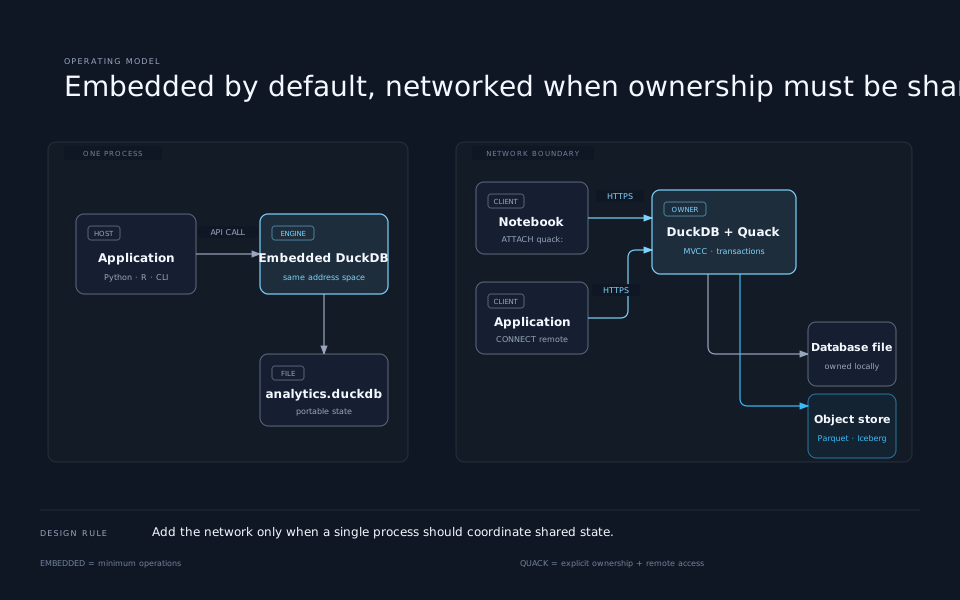
Quack travels over HTTP or HTTPS rather than inventing a new transport. Requests and responses use DuckDB’s own binary serialization, preserving nested values, decimals, intervals, and other rich types without converting them through JSON. A query needs one request-response pair after connection setup, and large results return in streamed chunks.
In v2.0, CONNECT becomes the clearer session-level command. A client can attach a Quack endpoint, connect to it, and run ordinary SQL remotely. The same abstraction can target PostgreSQL and MySQL: the remote-pushdown optimizer sends SQL to the source instead of pulling entire tables across the wire first.
That distinction matters. An attached catalog describes what data is available; CONNECT changes where the query runs. Pushing aggregation and filtering to the database that owns the data can turn a multi-gigabyte transfer into a few result rows.
A Server Mode Does Not Change the Workload
Networking does not magically turn a columnar analytical engine into a drop-in replacement for every transactional database. DuckDB has MVCC, transactions, and isolation, and Quack gives multiple clients one coordinated owner. It does not erase the design differences between analytical and row-oriented systems.
Use server mode where DuckDB’s strengths still define the workload: analytical scans, local or object-backed lakehouses, tenant-isolated warehouses, transformation services, and shared access to large DuckDB artifacts. Keep evaluating PostgreSQL, MySQL, or another purpose-built system when the center of gravity is high-rate point updates, a mature migration ecosystem, fine-grained operational controls, or application concurrency patterns that depend on row locks and long-established drivers.
The practical gain is architectural choice. A pipeline can use embedded DuckDB during transformation and Quack for a shared presentation layer. A data product can keep one database per tenant and expose each through an owner process. A laptop can connect to a remote catalog without giving up the same SQL dialect and nested types it uses locally.
Production use also widens the threat model. The current Quack documentation recommends TLS termination through a reverse proxy for remote deployments and supports scoped secrets for tokens. DuckDB SQL can access files, networks, extensions, and credentials with the privileges of its process, so untrusted SQL must be treated like untrusted shell or Python code. Server mode needs explicit authentication, network policy, resource limits, logs, backups, and upgrade discipline.
VARIANT Turns Semi-Structured Data into Columns
JSON is flexible at ingestion and expensive at analysis. A text JSON column must repeatedly parse values, carry field names, and discover types while queries run. Converting it to a rigid table improves performance but creates another problem: event payloads evolve, optional fields appear, and different records legitimately have different shapes.
DuckDB’s VARIANT type stores typed binary values whose shape may differ row by row. It can hold a number, string, list, or struct in the same column. More importantly, DuckDB detects common structure and “shreds” it into typed child columns. A field such as user.id can be compressed and scanned like data rather than recovered from a text blob for every query.
Version 2.0 completes that path through storage and execution. The engine can operate on the shredded representation, push extraction into scans, read and write shredded VARIANT values in Parquet, and inspect or search them with variant_* functions. Parquet interchange is especially useful because DuckDB can reconstruct variants written by other systems, including Snowflake-compatible shredded data.
For log and event pipelines, the result is a useful middle ground: retain heterogeneous records without paying the full text-JSON tax. It does not remove schema governance. Producers still need stable meanings, compatible types, and policies for fields that change shape. It simply lets physical storage adapt to the structure that is already present.
Triggers Bring Database-Side Reactions
Long-running services need behavior that happens beside a write, not later in an application callback. DuckDB 2.0 adds BEFORE and AFTER triggers, row- and statement-level execution, multiple triggers per event, transition tables, RETURNING, and trigger removal.
Audit logging is the obvious example. A statement-level AFTER UPDATE trigger can compare the old and new transition tables and insert every changed value into an audit table in one set operation. Other uses include maintaining derived tables, rejecting invalid transitions, publishing change records, or implementing internal engine features.
Triggers should remain small and observable. Hidden database behavior can surprise operators, complicate bulk loads, and make latency harder to explain. Prefer set-oriented statement triggers when possible, document their order and failure behavior, and test them as part of transaction semantics rather than as isolated snippets.
SQL Becomes a Better Pipeline Language
The release expands SQL in ways that reduce application glue:
APPROX NEAREST ... BY SIMILARITYexpresses top-k vector matching as a join.- Data-modifying CTEs let
INSERT,UPDATE,DELETE, andCOPYbecome pipeline stages withRETURNINGoutput. - Nested schemas provide another namespace level for large catalogs.
$variableworks wherever an expression is accepted.- JSON mutation functions add, replace, or remove fields without manual reconstruction.
- Recursive CTEs with
USING KEYcan aggregate state during iterative algorithms.
These features are not only syntax sugar. They let the optimizer see an operation as one relational plan rather than a sequence of client round trips. A staging-to-archive move, for example, can delete rows and feed the returned records directly into an insert. That makes the transaction boundary explicit and keeps intermediate data inside the engine.
The new NEAREST join is similarly valuable because similarity search becomes part of join planning. It does not make every vector workload an automatic fit for DuckDB, but it gives analytical queries a native way to combine relational filters with top-k matching.
Remote Data Needs Independent I/O Concurrency
Object storage changes the cost model of a scan. A CPU thread that requests one Parquet range and waits for the network is not doing useful query work. Adding more query threads can hide some latency, but it couples network concurrency to CPU parallelism and eventually wastes memory and scheduling overhead.
DuckDB 2.0 introduces asynchronous I/O across the engine so storage requests can progress independently from operators. Parquet reads and writes led the implementation, followed by CSV and DuckDB files. The engine can keep many remote requests in flight while a smaller pool of execution threads decodes, filters, joins, and aggregates the blocks that have arrived.
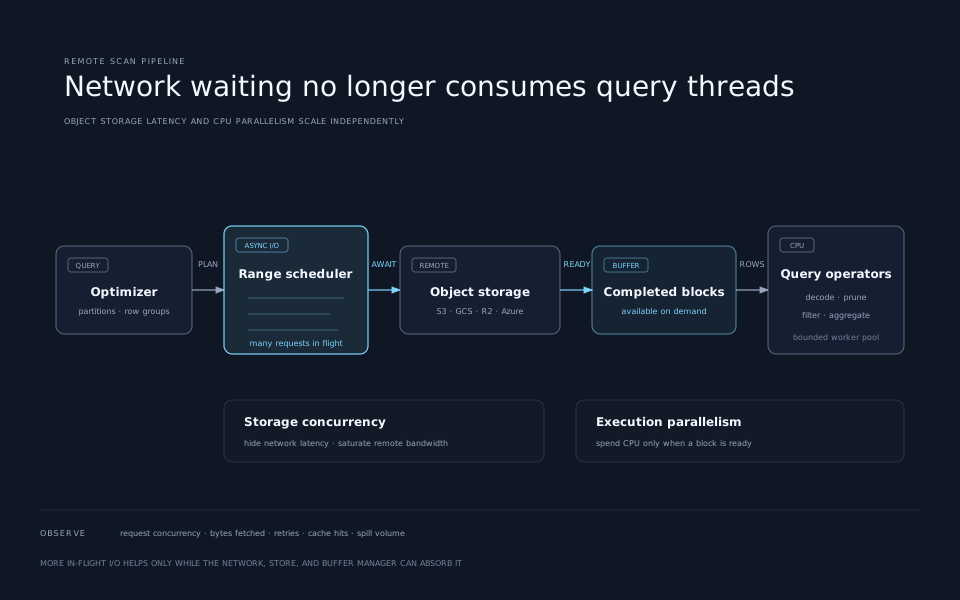
This separation improves throughput, but it also introduces knobs worth observing: request concurrency, bytes fetched, cache hit rate, retries, throttling, spill volume, and memory pressure. More outstanding reads are useful only while the object store, network, and local buffer manager can absorb them.
Existing Queries Get Faster Without New Syntax
Several optimizer and execution changes target work users already run. Partial aggregates can move below joins, duplicate aggregates can be reused, and large aggregations can spill rather than fail when memory runs out. The recursive CTE engine was rewritten; DuckDB’s preview benchmark reports a one-million-edge reachability query falling from 4.90 seconds in v1.5.4 to 0.12 seconds in the v2.0 preview.
Treat that 40× result as evidence about one improved execution path, not a promise for every query. The more broadly useful lesson is that recursion is no longer automatically a toy path inside the engine. Graph reachability, hierarchy traversal, and iterative SQL deserve fresh benchmarks against representative data.
Pruning also becomes much more capable. Zone maps and Parquet Bloom filters can skip row groups for nested types, decimals, UUIDs, IN lists, and selected function predicates such as prefixes or substring checks. Partition-aware planning can avoid irrelevant Hive, Iceberg, or DuckLake partitions before a scan begins. For lakehouse workloads, reading fewer files and row groups is often a larger win than processing each row faster.
Storage v2.0 Loads Less Up Front
The default storage format changes to v2.0.0. Adaptive radix tree indexes become buffer-managed instead of permanently pinned in memory, so a database with large indexes can open quickly and page index blocks on demand. Column metadata loads lazily, helping very wide tables. New defaults improve string compression, compact delete storage, and corruption validation.
The trade-off is forward compatibility. Newer DuckDB versions aim to read older files, but an older binary may not understand a file written with a newer storage version. DuckDB documents explicit storage compatibility settings and database copy/export paths for moving between versions. Before upgrading a fleet, inventory every producer and consumer of .duckdb files, including notebooks, scheduled jobs, embedded applications, and browser builds.
A safe rollout is deliberately boring:
- Copy representative databases and test the preview on those copies.
- Run correctness comparisons and workload-level benchmarks, not only microbenchmarks.
- Verify every client and extension against the same release candidate.
- Decide whether files must remain readable by an older deployment.
- Back up the original files and rehearse export/import or database-copy recovery.
- Upgrade consumers before allowing producers to persist the new default format.
A New Parser Makes SQL Extensible
DuckDB historically used a parser derived from PostgreSQL. Version 2.0 replaces it with a PEG-based parser designed and maintained for DuckDB. Users should mostly notice better source locations in error messages, not different query behavior.
The architectural payoff is grammar extension. Extensions can add syntax rather than forcing every domain feature through function calls or awkward string arguments. A Spark compatibility mode is the first explicit dialect target.
Parser replacement is also one of the clearest reasons to test real query corpora. Applications accumulate edge cases in generated SQL, quoting, comments, lambda syntax, parameter placement, and rarely used statements. Capture production queries with sensitive values removed, run them through the preview, and report incompatibilities before release.
Smaller Timezone Support, Stable Extensions
DuckDB previously depended on ICU for timezone-aware timestamps, calendars, and collations. Version 2.0 moves those capabilities into its own extension, built from IANA timezone data compressed to roughly 45 kB. The preview reports 2.2× faster conversion of 25 million timestamps and 2.6× faster German collation filtering over five million strings, while reducing the dependency footprint.
Extension authors get an even more consequential change. Many extensions currently build against an unstable C++ interface and must be rebuilt for each DuckDB release. The broadened stable C API is generated from a declarative, versioned specification, with CI checking that headers and ABI definitions cannot silently drift. An extension can target that interface once and remain binary-compatible across releases.
Organizations will also be able to host trusted extension repositories. A repository definition pins one or more RSA public keys, supports key rotation, and can point to HTTPS, S3, or a local path. That closes an important operational gap: internal extensions can use native install and load flows without being published to DuckDB’s public repositories.
“Stable” still needs a lifecycle policy. Teams should sign artifacts in CI, publish immutable versions, audit repository keys, test across supported DuckDB releases, and decide how vulnerable versions are revoked. A durable ABI reduces rebuild churn; it does not replace software supply-chain controls.
What to Evaluate Before the Release
DuckDB 2.0 invites experimentation, but the preview is not a reason to move every workload behind Quack. Start with the boundary that currently hurts.
If large database artifacts are copied between services, test one owner process plus remote clients. Measure query latency, concurrent readers and writers, recovery, backup, and rolling upgrade behavior. If object-store scans wait on network latency, compare request concurrency, transferred bytes, and end-to-end cost. If logs live in JSON strings, convert a representative sample to VARIANT and compare storage size, field extraction, schema drift, and Parquet interoperability.
For every path, preserve an embedded baseline. The strongest part of DuckDB 2.0 is not that the project abandoned “SQLite for analytics.” It is that the same engine can now stay inside one process when simplicity wins, cross a network when ownership must be shared, and push work to another database when moving data would be wasteful.
The DuckDB 2.0 preview describes the full release direction, while the Hacker News discussion shows why server mode resonates with teams already building single-owner wrappers and tenant-specific analytical services. The durable design rule is to keep the execution boundary explicit: run close to the data, move compact results, and choose the operational model that matches the workload rather than the novelty of the feature.