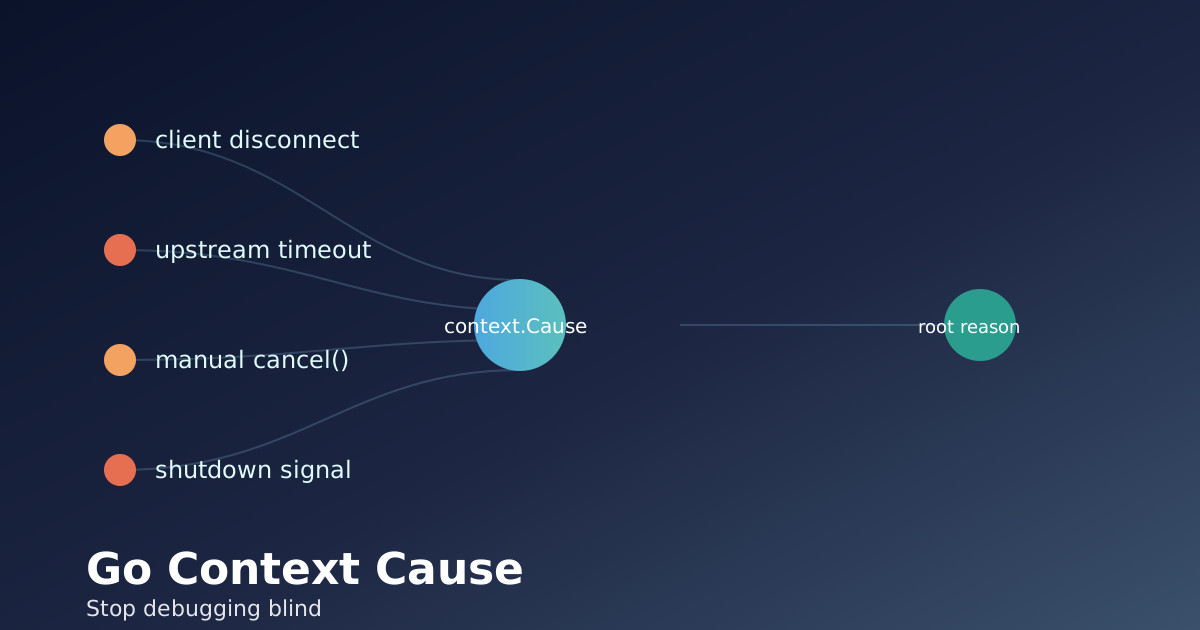
Go Context Cause: Stop Debugging Blind `context canceled` Errors
The Real Problem With Context Errors
ctx.Err() gives you two classes of failure:
context.Canceledcontext.DeadlineExceeded
That is useful at a category level, but weak for debugging. It does not answer:
- Did the client disconnect?
- Did an upstream deadline fire?
- Did our own code call
cancel()early? - Did shutdown logic terminate this request path?
Most teams start by wrapping returned errors with extra text. That helps localize where the cancellation surfaced, but still does not preserve the original cause of cancellation across layers.
What Go 1.20+ Changed
Go 1.20 added context.WithCancelCause and context.Cause. Go 1.21 added WithTimeoutCause and WithDeadlineCause.
This gave us a clean upgrade path:
- Keep using
ctx.Err()for broad category checks. - Attach domain-specific reasons using cause-aware cancellation.
- Query
context.Cause(ctx)for deep diagnostics and structured logging.
At a high level, this turns cancellation from a generic signal into a traceable failure event.
Pattern 1: Use WithCancelCause For Explicit Failure Paths
A good baseline is wrapping request-level work in one CancelCauseFunc and setting meaningful domain errors at the closest failure point.
func processOrder(ctx context.Context, orderID string) error {
	ctx, cancel := context.WithCancelCause(ctx)
	defer cancel(nil) // default if nothing more specific fires first

	if err := checkInventory(ctx, orderID); err != nil {
		cancel(fmt.Errorf("order %s inventory check failed: %w", orderID, err))
		return err
	}

	if err := chargePayment(ctx, orderID); err != nil {
		cancel(fmt.Errorf("order %s payment failed: %w", orderID, err))
		return err
	}

	if err := shipOrder(ctx, orderID); err != nil {
		cancel(fmt.Errorf("order %s shipping failed: %w", orderID, err))
		return err
	}

	return nil
}
This preserves high-value context:
- Which phase failed
- Which entity was involved (
orderID) - The original low-level error chain via
%w
And because first cancel wins, the most specific reason usually survives.
Pattern 2: Know The WithTimeoutCause Trap
WithTimeoutCause is excellent for labeling the timer-fired path, but it returns a plain CancelFunc, not a CancelCauseFunc.
That means a common defer:
ctx, cancel := context.WithTimeoutCause(parent, 5*time.Second, errTimeout)
defer cancel()
has an important behavior:
- If the timeout actually fires first:
context.Cause(ctx)contains your custom timeout cause. - If your function returns early and defer runs first: cancellation is recorded as generic
context.Canceled, and your custom timeout cause is not used.
So WithTimeoutCause is not a universal “always preserve cause” primitive. It is specifically “preserve cause when timeout path triggers.”
Pattern 3: Manual Timer If You Need Cause On Every Path
If your requirement is: “every cancellation path has a meaningful reason, including normal completion,” use WithCancelCause plus time.AfterFunc.
func processOrder(ctx context.Context, orderID string) error {
	ctx, cancel := context.WithCancelCause(ctx)
	defer cancel(errors.New("processOrder completed"))

	timer := time.AfterFunc(5*time.Second, func() {
		cancel(fmt.Errorf("order %s: 5s timeout exceeded", orderID))
	})
	defer timer.Stop()

	if err := checkInventory(ctx, orderID); err != nil {
		cancel(fmt.Errorf("order %s inventory check failed: %w", orderID, err))
		return err
	}

	if err := chargePayment(ctx, orderID); err != nil {
		cancel(fmt.Errorf("order %s payment failed: %w", orderID, err))
		return err
	}

	if err := shipOrder(ctx, orderID); err != nil {
		cancel(fmt.Errorf("order %s shipping failed: %w", orderID, err))
		return err
	}

	return nil
}
Benefits:
- One cancel entrypoint for all outcomes.
- Consistent cause semantics across success, timeout, and error exits.
- Less ambiguity in logs and postmortems.
Tradeoff:
ctx.Err()shape differs from true timeout contexts (context.Canceledvscontext.DeadlineExceededin some flows).ctx.Deadline()is not automatically propagated if you do only manual timer wiring.
Pattern 4: Stack Contexts If You Need Deadline Semantics And Rich Causes
Some downstream systems branch on errors.Is(err, context.DeadlineExceeded) or rely on real deadline propagation. In that case, layer both APIs:
- Outer
WithCancelCausefor domain reasons. - Inner
WithTimeoutCausefor timeout/deadline behavior.
The detail that matters is defer ordering. LIFO rules mean the cause-aware cancel should run before timeout cleanup in normal completion paths.
This approach is more complex, but it satisfies both constraints:
- Rich internal cause annotations.
- Deadline-compatible behavior for libraries and transport boundaries.
Logging Model That Scales In Production
A reliable pattern in handlers/middleware:
- Store
ctx.Err()as the cancellation class. - Store
context.Cause(ctx)as the reason. - Keep both as structured fields, not one concatenated string.
Example:
if ctx.Err() != nil {
	slog.Error("request aborted",
		"err", ctx.Err(),
		"cause", context.Cause(ctx),
		"path", r.URL.Path,
		"method", r.Method,
	)
}
This separation is operationally useful:
erris stable for broad dashboards.causeis high-cardinality detail for incident drills.
Practical Migration Plan
If your codebase is currently plain WithCancel/WithTimeout everywhere, migrate incrementally:
- Start at request boundaries and worker entrypoints.
- Switch core orchestration functions to
WithCancelCause. - Attach domain-specific causes at each major stage failure.
- Keep timeout strategy explicit:
WithTimeoutCauseonly where timer-path labeling is enough. - Add regression tests for cancel-order behavior and first-cancel-wins assumptions.
This gives you better diagnostics without a disruptive context refactor.
Why This Topic Hit HN
The technical novelty is small, but the operational impact is large. Engineers do not lose hours because Go lacks cancellation; they lose hours because cancellation intent disappears as errors bubble through abstraction layers.
Cause-aware contexts fix that gap with minimal API surface:
- clearer ownership of cancellation reasons,
- better logs,
- faster incident triage,
- less retry/alert guesswork.
For teams running high-concurrency Go services, this is a high-leverage upgrade.