The Human Attention Bottleneck in Agentic Software Development
Software development used to make its bottleneck obvious. A developer had to understand a problem, write the code, run it, find the mistake, and try again. The work could be slow, but the person doing it moved through one continuous feedback loop. Effort and understanding grew together.
Coding agents break that loop into two very unequal halves.
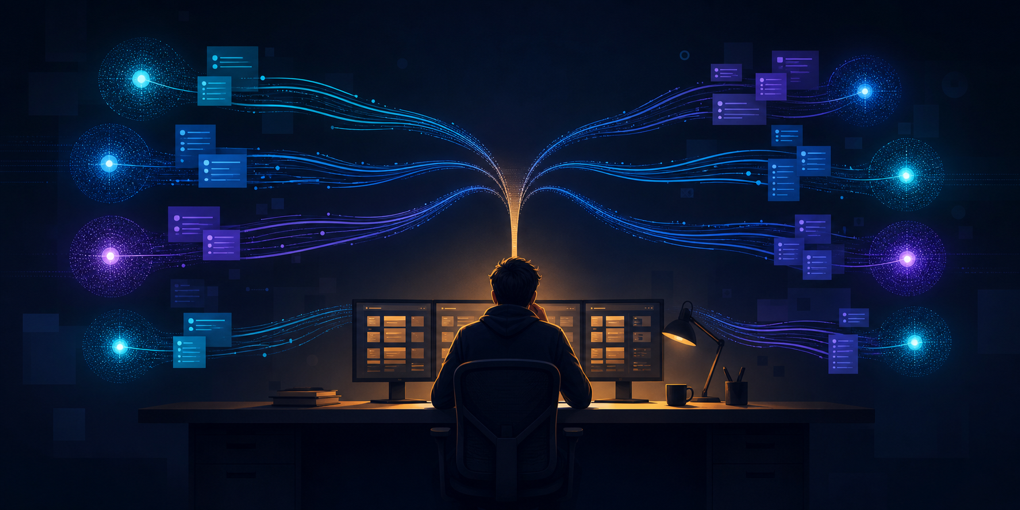
Generation becomes cheap. A prompt can start a refactor, a test suite, a migration, and a documentation update in parallel. Evaluation remains expensive. Someone still has to decide whether the output matches the real requirement, fits the architecture, handles the dangerous edge cases, and deserves to enter production.
That someone is now surrounded by more work than they could ever have created by hand.
This is the hidden cost of agentic development: the machine scales the supply of plausible changes faster than it scales the human capacity to understand them. Teams may ship more while their most experienced engineers spend less time designing and more time supervising an endless queue of almost-right work.
The problem is not that AI coding tools are useless. They are useful enough to change the shape of the job. The problem is treating human attention as an unlimited compatibility layer between abundant generation and reliable software.
Starting Work Is No Longer the Hard Part
Traditional development contains natural friction. Writing a feature takes long enough that a developer must choose what deserves attention. A difficult implementation forces the author to build a mental model. Tests, compiler errors, and debugging provide small, frequent signals of progress.
An agent removes much of that friction. It can explore an unfamiliar repository, draft a plan, edit many files, and run checks before a person would have finished locating the relevant code. That is a genuine improvement, especially for repetitive changes, unfamiliar syntax, scaffolding, and well-specified maintenance work.
It also creates an asymmetry. One developer can launch five tasks, but cannot carefully finish five tasks at once. Each session may be independent to the model, while all five share the same reviewer, product context, and production risk.
The result is a new queue:
- Agents produce changes in parallel.
- Each change arrives with a polished explanation and mostly passing checks.
- The human reconstructs the intent, inspects the diff, tests assumptions, and finds what automation missed.
- Corrections trigger another generation cycle and another review.
- Meanwhile, completed work from the other sessions keeps arriving.
Throughput at the beginning of the pipeline rises dramatically. The end of the pipeline is still one brain making sequential decisions.
Why Supervision Is More Tiring Than It Looks
Reviewing generated code is not passive. It demands a different and often harsher form of concentration than writing the same code.
When you write a function, you know why each branch exists because you made the decisions in order. When an agent writes it, you receive the decisions all at once. You must reverse-engineer the implementation, compare it with an intention that may exist only in your head, and remain alert for code that is locally convincing but globally wrong.
That last category is particularly expensive. Modern models rarely fail by producing obvious nonsense. They are more likely to use a real API in the wrong layer, invent a repository convention that sounds reasonable, satisfy visible tests while missing the user workflow, or broaden a change beyond its intended boundary. Plausibility increases review cost because the reviewer cannot safely skim.
Context switching makes the load worse. Supervising several agents means repeatedly swapping among different problem spaces. A database migration, authentication fix, frontend state bug, and deployment change may all be progressing at once. Every switch requires the human to reload constraints that the agent has held in its own context window.
The machines wait without discomfort. The developer experiences the queue as unfinished mental work.
This helps explain why agent-assisted days can feel productive and exhausting at the same time. More artifacts are created, but the human spends the day directing, checking, rejecting, and reloading context. The familiar reward of solving a problem is replaced by vigilance.
More Output Can Hide Less Progress
Counting generated output makes the new workflow look spectacular. More lines change. More pull requests open. More tasks move into review. Those metrics measure activity near the cheap end of the process.
They say little about whether the system became easier to operate, whether customers received a correct improvement, or whether maintainers understand what was merged.
Research is beginning to expose that distinction. An eight-month UC Berkeley study at a technology company found that generative AI expanded the scope and pace of work. Employees took on tasks they previously would not have attempted, filled natural pauses with prompts, and extended work into more hours of the day. The tool did not simply save time; it encouraged people to spend the saved time doing still more work.
Software maintenance shows a similar downstream effect. A study of open-source projects following GitHub Copilot adoption found more output from peripheral contributors, but also more rework. Core developers reviewed more code while their own original-code productivity declined. The exact numbers belong to that study and should not be generalized to every team, but the mechanism is familiar: inexpensive production transfers cost to the people responsible for quality.
A systematic review of research on LLM assistants reaches a broader conclusion. Faster development and lower task-starting overhead are real benefits, yet the literature also reports cognitive offloading, flow disruption, inconsistent quality, and reduced collaboration. Productivity cannot be reduced to how quickly code appears.
The useful unit is not generated code. It is trusted, understood, maintainable change.
The Reward Loop Has Changed
Programming has always included frustration, but it also contains many small rewards. A confusing subsystem becomes clear. A failing test turns green because the developer understood the cause. A clean abstraction replaces several special cases. A colleague learns something during review.
Agentic workflows can remove the mechanical work and accidentally remove those rewards with it. The developer may specify the destination, watch the machine travel there, and then inspect the result for hazards. The task completes, but the feeling of authorship is weaker and the burden of responsibility remains.
This is not universal. Some people care primarily about the finished product and find enormous satisfaction in turning ideas into working software faster. Others enjoy designing the system that lets agents operate safely. The important point is that motivation has moved, not disappeared automatically.
Teams should notice where the new rewards come from. If engineers no longer gain satisfaction from implementation, they need ownership of outcomes that still feel meaningful: making a user successful, simplifying an architecture, improving a verification system, teaching a teammate, or eliminating a recurring operational problem.
Without that replacement, organizations can increase delivery volume while quietly making the work less sustainable.
Treat Attention as a Capacity Constraint
The first practical change is to stop measuring agent capacity independently of review capacity.
If one engineer can responsibly validate two substantial changes in a day, generating ten does not create five times the throughput. It creates eight queued liabilities. Work in progress should be limited at the point where judgment is required, not at the point where prompts are cheap.
A sustainable workflow uses several constraints.
Keep the blast radius small
Give an agent one coherent outcome with explicit boundaries. Small diffs are easier to understand, easier to test, and easier to discard. A task that mixes behavior changes, cleanup, dependency upgrades, and formatting forces the reviewer to separate several risk profiles at once.
Make verification part of the assignment
The agent should not merely produce code. It should identify relevant checks, run them, inspect failures, and explain what remains unverified. Automated tests do not replace review, but they reduce the amount of state a reviewer must simulate mentally.
Verification should include the user-visible path when possible. A test suite can prove that the implementation satisfies its assertions while missing that the wrong thing was built.
Separate generation from judgment
Do not ask the same context that produced a plan to be its only critic. Use a fresh review pass, a second model, deterministic tooling, or a human who did not steer the implementation. Independence does not guarantee correctness, but it reduces the chance that one mistaken assumption flows through planning, coding, and approval unchallenged.
Preserve human-only work
Some work is worth doing manually even when an agent could attempt it. Writing a tricky algorithm, debugging an unfamiliar failure, or pairing on a design may be how an engineer develops the judgment that later makes supervision effective.
Manual work is not waste merely because automation exists. It can be training, calibration, exploration, or simply the part of the craft that keeps someone engaged.
Schedule recovery, not just execution
Agents make it tempting to fill lunch, evenings, and every short gap with another prompt. That turns formerly idle moments into background work and keeps several unresolved tasks active in memory.
Use explicit stopping points. Close sessions that are not worth finishing. Batch reviews instead of reacting to every completion. End the day with a written state that allows both the human and the machine to resume later. Recovery is part of the system’s reliability budget.
Encode Judgment Without Removing It
Experienced engineers repeat many of the same comments: use the existing abstraction, keep authorization at this boundary, do not swallow this error, avoid introducing another source of truth. Agent instructions, repository guides, linters, architectural tests, and reusable checklists can turn those repeated decisions into durable constraints.
That is a good use of automation. It moves stable knowledge earlier in the process so reviewers can focus on the change-specific questions.
But not all judgment can be encoded. Architecture involves trade-offs. Product requirements contain ambiguity. Taste depends on context. A rule file can tell an agent what the team usually does; it cannot decide when the current problem justifies an exception.
The goal is not to automate the reviewer out of existence. It is to reserve human attention for decisions that actually require a human, instead of spending it on conventions a machine could have checked before opening a pull request.
Design the Team, Not Only the Prompt
AI assistance can become isolating because a developer can ask a model questions that once started a conversation with a colleague. That is convenient, but it removes opportunities for shared context and informal teaching.
Teams should deliberately restore those connections. Review difficult agent-produced changes together. Hold short design conversations before parallel work begins. Share failed prompts and discarded approaches, not only successful demos. Rotate who operates and who reviews so knowledge does not concentrate in one exhausted gatekeeper.
This also protects junior engineers. If entry-level implementation is delegated while senior engineers retain only architecture and review, the organization may remove the path by which people learn to become senior. Learning requires making decisions, seeing consequences, and receiving feedback from other humans. A generated diff followed by a silent approval is a weak substitute.
The team must decide which tasks are delivery and which tasks are development of capability. Both matter.
A Better Definition of Productivity
Agentic software development needs a wider scorecard. Useful questions include:
- How long does a change take from request to trusted production behavior?
- How much review and rework does it create for other people?
- Can the team explain and operate the resulting system?
- Did the change improve or weaken future development speed?
- Are engineers learning, collaborating, and recovering adequately?
- How many generated tasks were abandoned after consuming review attention?
These questions make the human cost visible. They also prevent a fast generator from receiving credit for work that merely moved downstream.
AI coding agents are not ordinary productivity tools. They are capacity multipliers attached to a pipeline whose scarcest resource is judgment. Used carefully, they can remove drudgery, accelerate exploration, and let a small team attempt valuable work that previously stayed on the backlog. Used without limits, they turn senior engineers into overloaded schedulers and quality gates.
The durable advantage will not come from running the most agents. It will come from building a system in which generated work arrives at a rate humans can understand, verify, and care about.
The code can now write itself surprisingly often. The responsibility cannot.
Sources
- The Human-in-the-Loop is Tired
- Hacker News discussion
- AI promised to free up workers’ time. UC Berkeley Haas researchers found the opposite
- AI-assisted Programming May Decrease the Productivity of Experienced Developers by Increasing Maintenance Burden
- The Impact of LLM-Assistants on Software Developer Productivity