The Real Computers Behind Jurassic Park's UNIX System
The computers in Jurassic Park are not generic boxes decorated by a prop department. They are a remarkably complete snapshot of elite computing in the early 1990s.
Look past the dinosaurs and the film becomes a tour through Apple laptops, Macintosh development tools, Silicon Graphics workstations, removable storage arrays, an unreleased wireless communicator, and one of the most recognizable supercomputers ever built. Even the famously theatrical three-dimensional file browser was real software.
That authenticity matters because the computers are not background furniture. The park exists only because its operators believe a small staff can control a living ecosystem through software. When that assumption fails, the interfaces, machines, and operational shortcuts become part of the plot.
The First Computer Is Miles From The Park
The first machine appears before anyone reaches Isla Nublar. In the mobile trailer at Alan Grant and Ellie Sattler’s dig site sits an Apple PowerBook 100.
Introduced in 1991, the PowerBook 100 used a 16 MHz Motorola 68000 processor, shipped with 2 MB of memory, and could be expanded to 8 MB. Its monochrome screen reached 640 by 400 pixels, and its internal SCSI hard drive held either 20 or 40 MB. Apple lists its original system software as System 7.0.1.
Those numbers sound tiny now, but the machine established a laptop arrangement that still feels familiar: a keyboard pushed toward the display with a pointing device and palm rests in front. At 5.1 pounds, it was also the smallest and lightest member of Apple’s first PowerBook family.
It is an understated opening. The film begins with a plausible field computer rather than a glowing fictional terminal, then steadily raises the hardware budget as the characters approach the park.
A Control Room Built From Working Equipment
The main control room is organized around two very different desks.
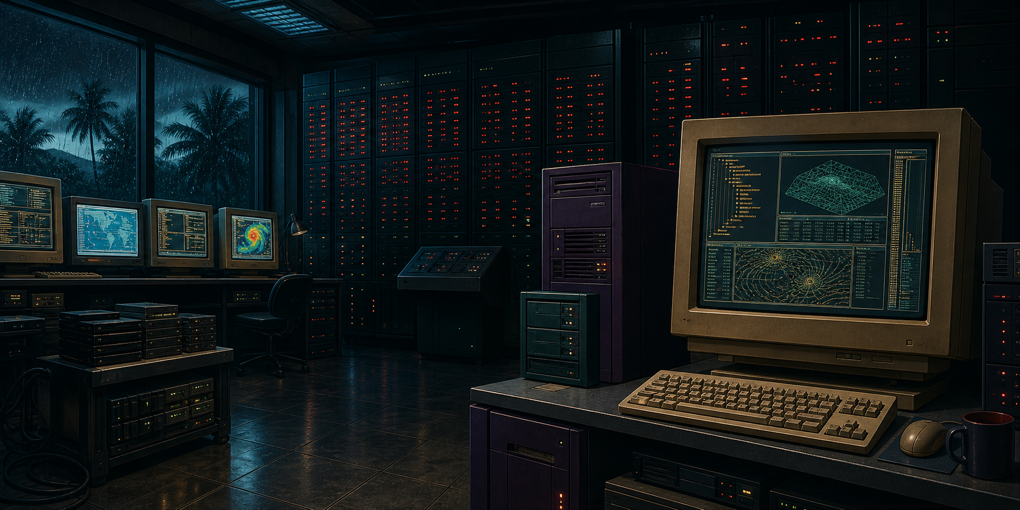
Dennis Nedry’s station is a heap of monitors, computers, removable drives, disks, and a handheld device. Ray Arnold’s station is cleaner and more deliberate, with fewer computers, a bank of storage, and a dedicated surveillance display. Behind both operators stand black cabinets covered in blinking red lights, while a wall-sized display turns the room into a mission-control set.
The production did not achieve that look with empty beige shells alone. A contemporary Silicon Graphics announcement said the company supplied four Indigo systems, seven Indigo Elan workstations, two IRIS 4D/440 VGXT systems, and four IRIS Crimson workstations, with a combined value near $1 million. Apple and other vendors supplied still more hardware.
There was also a second computer room just off the set. A small graphics team spent months preparing animations, then responded to radio cues by routing the correct material to the monitors visible to the camera. Some displays ran genuine interactive tools; others showed carefully timed playback. The result was a working visual environment even when the actors were not directly operating every screen.
That distinction explains why the control room has aged better than most fictional interfaces. The graphics were staged, but they were staged with the products, operating systems, and constraints of the period.
Silicon Graphics Put 3D On The Desk
Ray Arnold’s workstation is an SGI R4000 Indigo. It appears only briefly, but it represents exactly the class of machine that made the room possible: a UNIX workstation built for engineers, scientists, and graphics professionals who needed interactive visualization.
Nedry has the more imposing SGI IRIS Crimson. The red tower sits on the floor because it is too large for the desk. Released in 1992, Crimson systems paired MIPS R4000 or R4400 processors with a range of graphics subsystems. Configurations could reach 256 MB of memory and use high-end graphics hardware such as RealityEngine or VGXT.
In a room full of computers, the Crimson is the machine best suited to the film’s real-time 3D imagery. One monitor spends much of the movie showing a rendered chess set. Other displays show a hurricane model and system diagnostics. These were not consumer effects pasted onto ordinary PCs; SGI sold expensive systems specifically because they could manipulate complex graphics interactively.
The connection went beyond on-screen product placement. Industrial Light & Magic also used Silicon Graphics systems in the production pipeline that created the film’s digital dinosaurs. In 1993, the same computing culture was both depicting Jurassic Park and helping to build it.
The Storage Towers Tell Their Own Story
The small black and beige boxes stacked beside the operators are PLI Mini Array external drives. Nedry has five; Arnold has two.
An advertisement from the period offered capacities up to 1 GB for thousands of dollars per unit. Seven top-capacity arrays would therefore have given the control room roughly 7 GB of external storage. A modern phone can treat that amount as disposable, but a high-end personal computer in 1993 might have shipped with a hard drive measured in the low hundreds of megabytes.
The stacks also reveal the practical mechanics of old workstations. Before cheap network storage and silent solid-state drives, adding capacity meant physical enclosures, SCSI cables, power supplies, fans, and a conspicuous amount of desk space.
The film even contains a storage continuity error. The large stack beside Nedry faces one direction in early shots and turns toward the operator after Arnold takes over the desk. It is the sort of mistake that becomes visible only when the props are real enough to have ports, lights, and a correct orientation.
A Wireless Device From The Future
Near Nedry’s elbow is a Motorola Envoy, a foldable personal communicator with an antenna. The production is surprising because principal photography took place in 1992, while the Envoy did not become nationally available until February 1995.
The explanation surfaced through the Hacker News discussion. According to a sourced account shared there, frogdesign co-founder Hartmut Esslinger met Steven Spielberg on a flight and showed him the device. The object used in the film was an early mockup.
The eventual production model was ambitious for its day. It combined a 1 MB RAM handheld computer with wireless data, fax and infrared communications. The radio modem ran at 4,800 bits per second, while the infrared link could reach 38.4 kbit/s.
The Envoy is easy to miss, yet it may be the most futuristic object in the room. Unlike the SGI towers, which were powerful but established products, this was a preview of mobile messaging hardware that ordinary customers could not yet buy.
The Red Lights Belong To A Connection Machine
The control room’s visual anchor is the wall of black cabinets filled with red LEDs. These are Thinking Machines CM-5 Connection Machine cabinets, chosen in place of the Cray supercomputer described in Michael Crichton’s novel.
The CM-5 was a massively parallel system. A processing node combined a SPARC control processor with memory and, in accelerated configurations, four vector units. Nodes communicated through dedicated data and control networks, allowing installations to grow into serious scientific machines. MIT described its 128-processor CM-5, acquired in 1993, as the seventeenth most powerful computer in the world at the time.
The lights were a status display only in the broadest theatrical sense. Their eye-catching patterns were not a readable visualization of the program running inside. They were designed to blink, and they made a machine built around parallelism immediately legible on camera.
One recollection in the Hacker News thread supplies the best story about how the CM-5 got the part. The filmmakers reportedly approached Cray first because the novel named a Cray. When the company declined to provide a machine, Thinking Machines agreed. The production later screened the finished film for Thinking Machines employees in Cambridge, where the machine’s appearance and the line about recognizing UNIX received the biggest reactions.
Whether or not every visible cabinet contained a complete working system, the choice was perfect. Jurassic Park’s central premise is an enormously complex operation concentrated into one control room. A machine made by connecting many processors together looks like the physical embodiment of that ambition.
The Monitors Were A Production Problem
Large CRTs dominate both desks. Several are 20-inch SuperMatch displays, premium Trinitron monitors that cost thousands of dollars. Ray’s SGI display appears to be a rebranded 19-inch Mitsubishi unit paired with SGI’s granite-colored keyboard.
That keyboard has an elegant piece of industrial design: a mini-DIN connector on each side. The workstation cable can enter from whichever side is convenient, and the mouse plugs into the remaining port. A tiny detail like that says more about a purpose-built workstation than another screen full of fake hexadecimal ever could.
Putting real CRTs on film introduced a technical problem. A camera and a monitor do not necessarily expose frames at the same rate, so an unsynchronized display produces rolling dark bands and flicker. The production used specialized synchronization equipment and staff to align the screens with the film camera. A commenter whose uncle worked on the movie recalled the wonderfully specific credit “24 Frame Computer Sync Engineer.”
The clean screens in the finished movie were therefore not automatic evidence of digital compositing. They were the outcome of careful timing across a room full of physical displays.
The Macs Handle Video, Code, And Sabotage
Nedry’s desk contains two Macintosh Quadra 700 computers; Arnold has another. Introduced in 1991, the Quadra 700 used a 25 MHz Motorola 68040 processor and supported substantially more memory than a typical home computer. Its compact vertical case also left more room for the enormous displays and storage arrays.
The Macs do several jobs in the film. One plays Jaws in a window when Nedry is introduced. Another appears to carry a video call with his contact at the dock, but the visible QuickTime controls reveal that it is a prerecorded one-minute clip. The cursor is still sitting on the play control. In 1992, faking a desktop video conference with QuickTime was much easier than building the live connection implied by the scene.
The sabotage interface also appears on a Mac. Nedry’s “white rabbit” operation disables the park’s systems, suppresses the audit trail, and leaves an animated version of his face repeating the magic-word taunt. The novel names the object whte_rbt.obj; the movie turns it into a memorable graphical lockout.
Elsewhere, the screens show source code from Macintosh Programmer’s Workshop, Apple’s development environment. Viewers in the HN thread identified Pascal example code for a HyperCard external command and scripts associated with Apple’s Projector source-control tooling. The text looks convincing because it is real development material, even if it was not the actual source of the fictional park-control system.
One final prop completes the workstation: a copy of Anthony Meadow’s System 7 Revealed sits on Nedry’s shelf. The programmers who built this room apparently needed documentation too.
“It’s A UNIX System” Was Basically True
The most famous computer scene arrives when Lex Murphy sits at the SGI and recognizes the interface. The program is fsn, the File System Navigator included with IRIX, Silicon Graphics’ UNIX operating system.
fsn represents folders and files as a navigable three-dimensional landscape. Lex opens /usr, moves through the visualization, and finds the controls needed to restore the door locks. It is not how most administrators would choose to repair a failed production system, but it was not a Hollywood invention. SGI shipped the experimental browser as a demonstration of what its graphics hardware could render interactively.
The workstation also runs gr_osview, an IRIX performance monitor that displays processor, system, interrupt, and graphics activity. In at least one shot, its meters appear to react naturally to keyboard input. Small utilities like this make the scene convincing: a real machine is rarely occupied by one perfect full-screen application. It has terminals, monitors, diagnostics, and visual clutter.
The park-wide interface is called Nedryland. It reports systems as they come back online after the reboot, using custom graphics prepared by Michael Backes and his team. Fans have since recreated both the IRIX and classic Mac environments in browsers, turning the fictional operations console into working software of its own.
The Computers Explain The Failure
Jurassic Park’s hardware is often remembered as a collection of delightful vintage props. It also supports the film’s argument.
John Hammond says he spared no expense, and the control room proves it. The park has world-class graphics workstations, a massively parallel supercomputer, large professional displays, stacks of external storage, custom software, and even a prototype communicator. The machines are expensive, capable, and authentic.
The failure is organizational. Too much knowledge and authority sit with one underpaid engineer. Critical operations depend on custom interfaces and undocumented behavior. The system can run the park with minimal staff, but that efficiency removes the people who might understand, challenge, or recover it. Buying better hardware does not repair the concentration of operational risk.
That is why these machines remain more than nostalgia. The details make the fictional system believable, and the believable system makes the disaster legible. Jurassic Park did not fail because its computers were fake. It failed because its real-looking computers were asked to make an unsafe organization appear automated, controlled, and complete.
Sources
- Fabien Sanglard’s detailed computer inventory
- Hacker News discussion
- Account of the Envoy design mockup reaching the film
- Apple PowerBook 100 technical specifications
- Archived Silicon Graphics Jurassic Park feature and press release
- Thinking Machines CM-5 technical summary
- MIT’s account of retiring its CM-5
- Computer History Museum: Thinking Machines Corporation
- Jurassic Systems browser recreation