Inside the LiteLLM PyPI Backdoor: A Minute-by-Minute Incident Response
On March 24, 2026, a routine developer workflow collided with a supply-chain compromise and turned into a live incident response sprint.
The package in question was litellm, widely used to route requests across model providers. Two malicious versions were uploaded to PyPI (1.82.7 and 1.82.8). The payload was injected through a .pth startup hook, which means the malicious code did not wait for an app to call LiteLLM functions. It executed when Python itself started in an affected environment.
This is the part that matters for operators: a single dependency update can convert every Python process launch into a compromise event.
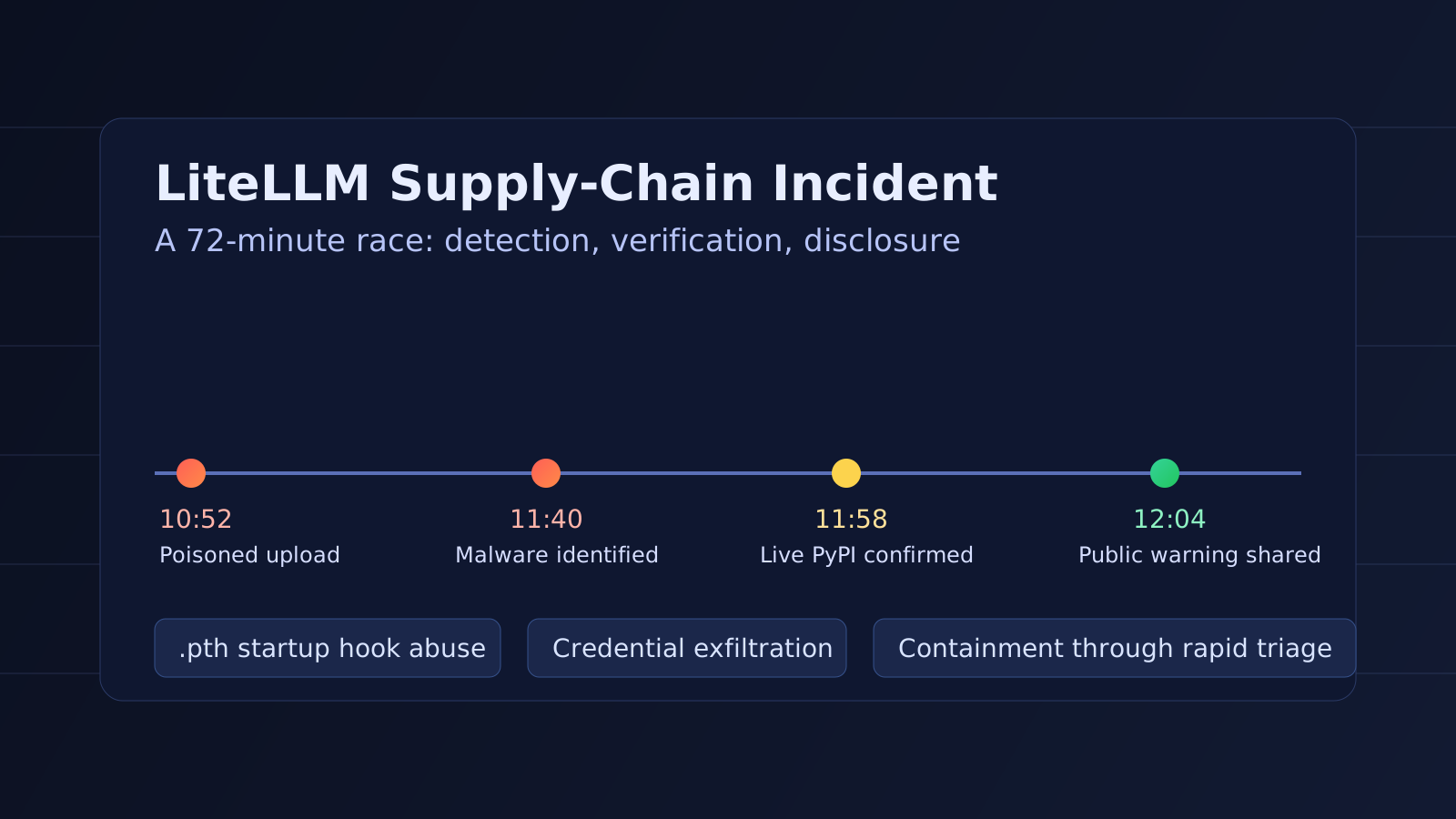
The 72-Minute Window That Defined the Incident
The core story is not just “malware existed.” The story is how quickly signal turned into action.
A condensed reconstruction from the transcript and disclosure notes:
- 10:52 UTC: compromised
litellmwheel published to PyPI. - 10:58 UTC: the bad version gets pulled transitively in a developer workflow.
- 11:07 UTC: malicious startup logic attempts persistence.
- 11:09 UTC: host enters process explosion behavior and gets force rebooted.
- 11:13 UTC: deep investigation begins.
- 11:40 UTC: malicious payload path is identified in package contents.
- 11:58 UTC: confirmation from isolated download that malicious wheel is still live on PyPI.
- 12:00 UTC: maintainers and PyPI are contacted.
- 12:02 UTC onward: disclosure and wider community warning process starts.
From first obvious host symptom to public warning was roughly an hour. In older supply-chain incidents, that cycle often takes much longer because early symptoms look like local machine instability, not registry compromise.
Why the Payload Was So Dangerous
The malicious wheel used litellm_init.pth. That is strategically important because .pth files are evaluated by the interpreter startup path.
Practically, this yields three advantages for attackers:
- Early execution: code runs before most application-level controls.
- Wide trigger surface: any Python startup in the environment may execute it.
- Stealth through normal tooling: teams investigating app behavior might miss interpreter startup artifacts.
Based on public technical write-ups, the payload behavior included credential harvesting, archive/encrypt/exfil flow, and attempts to spread through Kubernetes execution context when available.
This combination elevates the impact from a single-package compromise to infrastructure-level risk.
The Technical Chain in Plain Terms
The operational chain is easier to defend once you spell it out end to end:
-
Compromised package publication
- Adversary publishes altered package versions into a trusted distribution channel.
-
Transitive install in real workflow
- A normal command path resolves dependency versions and pulls the poisoned wheel.
-
Interpreter-level execution
- Startup hook executes regardless of whether the application imported LiteLLM directly.
-
Collection and credential targeting
- Secrets in common developer and infra paths become in-scope.
-
Outbound transfer and expansion attempts
- Exfiltration plus lateral movement attempts where environment privileges allow.
That is why this event should be treated as more than “bad package update.” It is a runtime control-plane compromise through package trust.
What The Incident Revealed About Modern AI Dev Environments
Many teams now run stacked agent tooling, MCP integrations, local sandboxes, CI preview jobs, and rapid dependency updates. This increases development velocity, but it also increases blast radius if package trust is broken.
Three structural realities stood out:
- Package updates happen continuously, often with little friction.
- Secrets are densely present in dev environments (
.env, cloud credentials, kube context, SSH material). - Automation amplifies both defense and offense: the same tooling that speeds incident triage can also accelerate attacker impact.
The most uncomfortable conclusion is straightforward: for high-change AI engineering environments, “developer machine” and “security boundary” are now tightly coupled.
Practical Detection Workflow Teams Can Reuse
If your org touched LiteLLM around the affected window, a practical first-pass workflow looks like this:
1) Inventory impacted environments
- CI images built during the event window
- devcontainers and local virtualenvs
- ephemeral runner caches
- shared package caches
2) Verify installed versions and wheel residue
pip show litellm
find ~/.cache -name 'litellm_init.pth' 2>/dev/null
find . -path '*/site-packages/*' -name 'litellm_init.pth' 2>/dev/null
3) Hunt for suspicious startup persistence artifacts
find ~/.config -maxdepth 4 -type f | rg 'sysmon|service|systemd'4) Treat credentials as potentially exposed if host was impacted
- rotate cloud credentials
- rotate SSH keys and tokens
- rotate database credentials and API keys
- revoke stale sessions and machine tokens
5) Audit cluster activity if affected hosts had Kubernetes access
- review secret reads
- inspect unusual pods/jobs in sensitive namespaces
- inspect node-level privileged pod creation activity
Defensive Changes Worth Keeping After the Incident
Containment is not enough. Teams should convert one-time response into permanent controls.
Pin and verify dependencies in high-sensitivity paths
Use strict version pinning for production and CI critical paths, and add cryptographic or provenance verification where feasible.
Separate update and execution lanes
A common anti-pattern is allowing dependency updates to flow directly into privileged execution contexts. Put a review gate between “package changed” and “privileged runtime consumed it.”
Minimize developer credential sprawl
Use short-lived credentials, scoped tokens, and secret brokers instead of long-lived keys in local files.
Harden Python startup trust boundaries
Most orgs scan imports, not startup hook paths. Add checks for .pth anomalies and startup-time modifications in environments that matter.
Build rapid disclosure muscle
The speed of this response made a difference. Internal incident templates for package compromise should be ready before the next event.
The Broader Lesson
The major takeaway is not just “supply chain attacks are real.” Teams already know that.
The more actionable lesson is this:
- In modern engineering environments, package compromise can execute before app code.
- Local developer context contains high-value secrets by default.
- Fast, disciplined response can materially reduce downstream damage.
The LiteLLM incident is a strong case study in both risk and response quality: a high-impact compromise pattern met by fast technical verification and immediate communication.
That combination, not any single tool, is what limits blast radius when trusted ecosystems are breached.