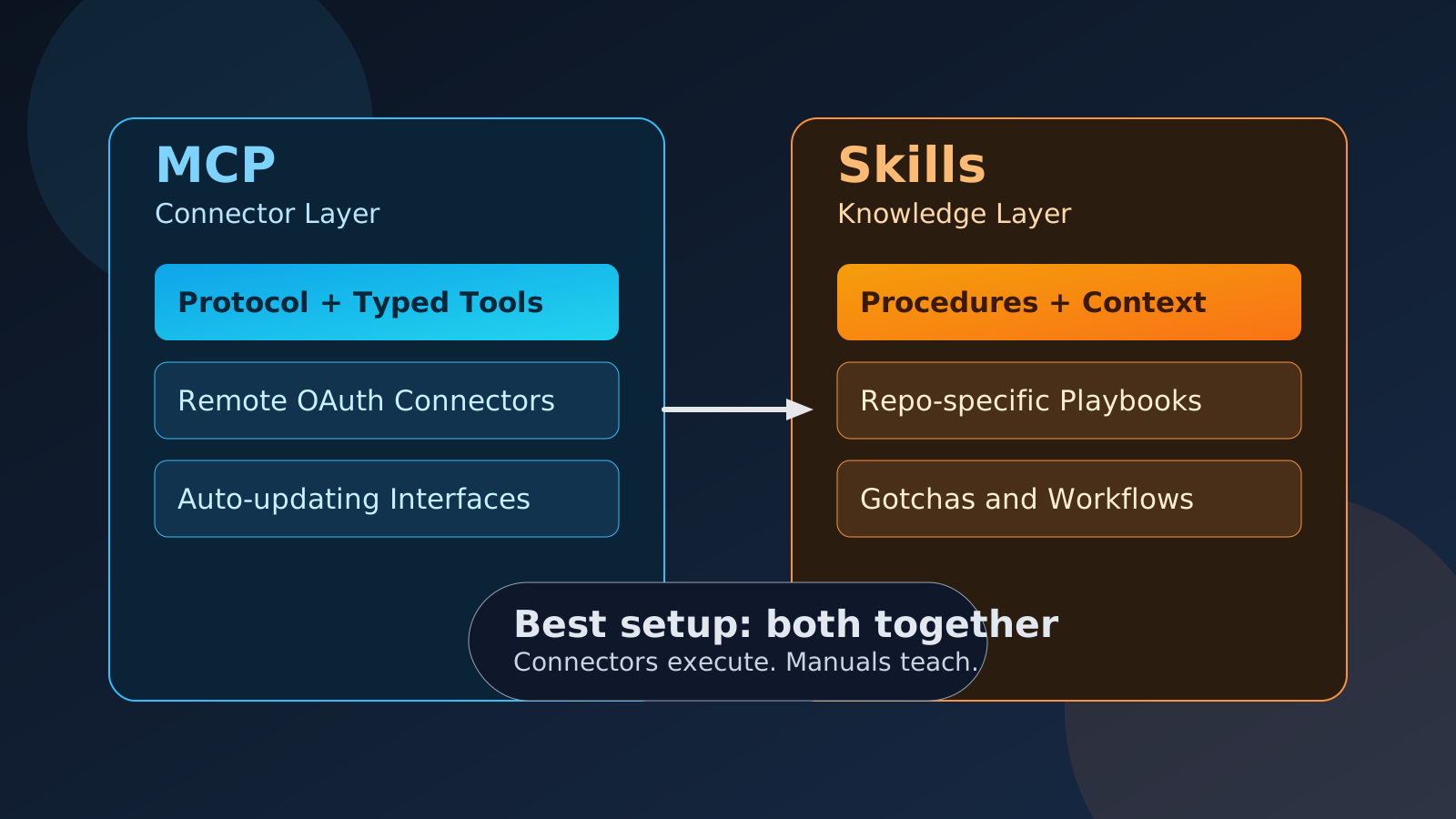
MCP vs Skills: Build Connectors, Keep Manuals
A lot of AI developer discourse in early April 2026 revolved around one claim: skills are replacing MCP. After digging through the piece and related docs, the strongest takeaway is not “pick one.” It is this:
- MCP is the connectivity/runtime layer.
- Skills are the knowledge/behavior layer.
If you force either one to do both jobs, you get avoidable complexity.
Why This Debate Matters
When teams wire LLMs into real systems, they quickly hit the same design problem: how should the model access tools and services safely, portably, and with enough context to behave correctly?
The industry now has two common patterns:
- Build a protocol-level interface that exposes tools and resources to model clients.
- Ship a markdown instruction package that teaches the model how to perform work.
Both approaches are useful, but they are not interchangeable.
Treating them as substitutes creates bad architecture decisions:
- Trying to run service integrations only through local CLIs and instruction files.
- Overloading protocol connectors with procedural guidance that belongs in human-readable docs.
- Duplicating auth and operational logic in too many places.
What MCP Gets Right
The Model Context Protocol was designed as a standard interface between clients and tool providers. In practice, that gives you architectural advantages that are hard to replicate with ad hoc CLI workflows.
1. Service Interfaces Stay Service-Owned
With MCP, the service defines the capability surface and clients consume it consistently. That avoids every team inventing custom wrappers for the same API.
2. Better Remote Operability
Remote MCP endpoints can work without every user setting up local binaries and hand-managed scripts first. For organizations, that lowers onboarding friction and reduces environment drift.
3. Cleaner Authentication Flow
Protocol-based integrations can centralize auth patterns instead of requiring each skill package to explain token placement, shell setup, and secret handling from scratch.
4. Portability Across Clients
When clients support MCP, the same connector can be reused across different environments and devices. That gives teams an architecture that survives tool churn.
5. Stronger Execution Boundaries
Exposing explicit tools is usually safer than granting broad shell behavior and hoping instructions are followed perfectly. It narrows what the model can do by design.
Where Skill-Only Integration Breaks Down
The original argument highlighted a common failure mode: skills that are great on paper but depend on CLI execution in environments that do not expose shell access.
That gap still appears frequently in real workflows:
- The skill says “install X CLI first,” but the client cannot install anything.
- The skill says “set this token,” but the runtime hides filesystem or environment state.
- The skill says “run these commands,” but the client only supports declarative tool calling.
In those cases, the instruction layer is carrying too much operational load.
There is another practical issue: skill portability is uneven across tools. Different runtimes use different packaging assumptions, metadata formats, and installation paths. What works cleanly in one coding client may fail in another.
Finally, large instruction files can create context overhead. If a model only needs one operation, loading pages of procedural setup is expensive compared to selecting a specific typed tool exposed by a connector.
Where Skills Clearly Win
None of this means skills are weak. They are the best place for reusable knowledge that improves model behavior:
- Team conventions, coding standards, and communication tone.
- Project-specific workflows and branching rules.
- Domain definitions and internal terminology.
- Repeated pitfalls discovered during prior sessions.
Skills are especially strong when they encode hard-won operational context. Example: “for this connector, set date format as YYYY-MM-DD, paginate this endpoint in batches of 100, and avoid this unreliable tool unless fallback is needed.”
That is not protocol design. That is execution wisdom. Skills are perfect for it.
A Practical Split That Works
The strongest implementation pattern is a two-layer model:
Layer 1: Connectors (MCP)
Use MCP for:
- Access to external services and applications.
- Stable tool signatures and callable actions.
- Auth/session handshakes handled at integration boundaries.
- Runtime operations that must be reliable and portable.
Layer 2: Manuals (Skills)
Use skills for:
- How to think before calling tools.
- Which tools to prefer in specific scenarios.
- Domain and business context that changes model decisions.
- Anti-patterns, gotchas, and troubleshooting playbooks.
In plain terms: connectors perform; manuals guide.
Decision Matrix for Teams
If your team is deciding what to build next, this matrix avoids most mistakes:
- Need cross-client, durable service access? Build or adopt an MCP connector.
- Need reusable team behavior and process guidance? Write a skill.
- Need both? Start with the connector, then add a skill that teaches best usage patterns.
- If a skill starts with “install this CLI and manage these secrets” ask whether that should be a connector instead.
Design Recommendations You Can Apply This Week
- Audit every existing skill and tag each section as either
knowledgeorruntime. - Move runtime-heavy instructions (auth flows, CLI dependency chains, shell orchestration) into connector-backed integrations where possible.
- Keep skills short, composable, and scoped to behavior and context.
- Add a “known gotchas” section to each skill tied to real incidents.
- For every connector, provide a companion skill that explains tool selection strategy.
This split makes systems easier to maintain and easier for models to use correctly under pressure.
The Real Outcome of the MCP vs Skills Argument
The most useful interpretation of this debate is not ideological. It is architectural.
- If your goal is reliable, portable system access, protocols win.
- If your goal is reusable decision context, manuals win.
- If your goal is production-quality agent workflows, you want both in deliberate combination.
That framing explains why the “MCP or skills” question keeps resurfacing. Teams are trying to solve two different problems with one mechanism.
The better path is to separate concerns and let each layer do its job.