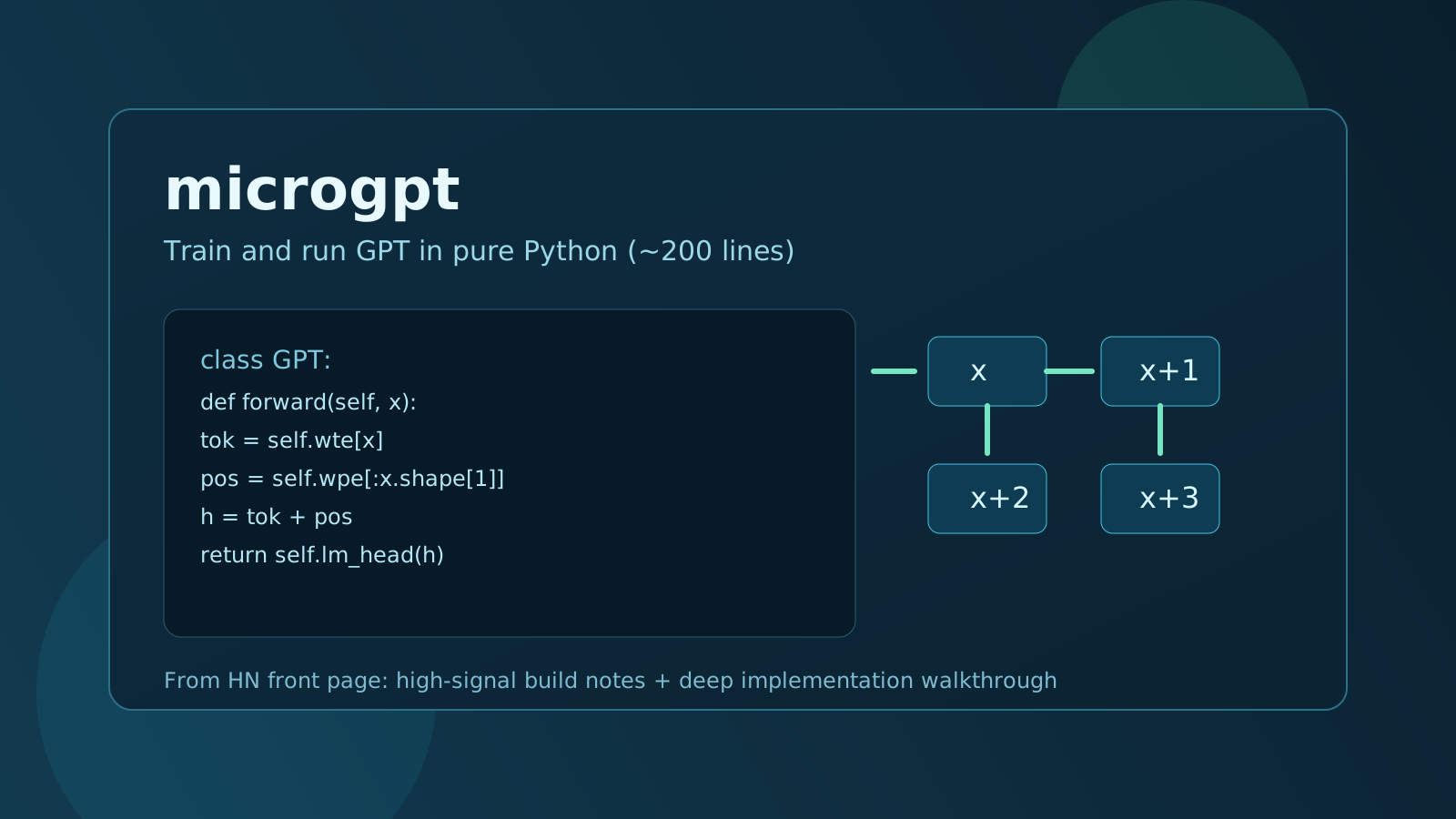
Microgpt: A ~200-Line Pure Python GPT by Andrej Karpathy
On March 2, 2026, one of the top stories on Hacker News was Microgpt (id=47202708). At drafting time, it had 1,794 points and 301 comments, comfortably above the threshold for a high-signal engineering discussion.
The project is simple to describe and hard to execute well: implement training and inference for a GPT-style language model in roughly 200 lines of dependency-free Python, while still keeping the implementation educational and runnable.
Why Microgpt Got So Much Attention
Microgpt sits at the intersection of three things engineers care about:
- Compression of complexity: distilling a modern transformer pipeline into code small enough to reason about end to end.
- Practical pedagogy: not just theory slides, but code you can execute and modify.
- Model literacy pressure: teams increasingly rely on LLM tooling, but many engineers still lack intuition about tokenization, attention flow, and training dynamics.
For many readers, this was less about beating benchmarks and more about reclaiming first-principles understanding.
What the Original Post Covers
Karpathy’s post focuses on building a minimal GPT implementation without external ML frameworks, emphasizing conceptual clarity over production performance. The walkthrough includes:
- A compact model architecture with token + positional embeddings.
- Forward pass mechanics and logits generation.
- A tiny training loop that demonstrates optimization dynamics.
- Inference mechanics that show next-token prediction in action.
The canonical resources linked from the post are:
- The article: karpathy.ai/microgpt
- The code gist: microgpt.py
- Colab playground: Interactive notebook
Engineering Takeaways for Real Teams
Even if you never train a transformer from scratch in production, microgpt has real value for working engineers.
1. Better Debugging Intuition
When an AI coding assistant gives low-quality suggestions, engineers with model intuition can diagnose likely failure modes faster:
- bad context windows,
- token boundary mismatch,
- prompt structure issues,
- or generation settings that push the model off distribution.
A compact implementation helps map these symptoms to concrete internals.
2. Better Evaluation Discipline
Microgpt makes it obvious how easy it is to produce outputs that look coherent but are statistically brittle. That naturally pushes teams toward stronger eval practices:
- task-specific test harnesses,
- deterministic prompts for baseline comparisons,
- and regression checks for prompt/template changes.
3. Better Tooling Architecture Decisions
Understanding model mechanics influences system design choices, for example:
- when to use retrieval vs larger prompts,
- where to spend latency budgets,
- and how to shape structured outputs for downstream reliability.
Why Minimal Implementations Matter in 2026
The market is moving toward larger context windows, stronger agents, and increasingly abstract interfaces. That trend helps adoption, but it can hide foundational mechanics.
Projects like microgpt provide a counterweight: they keep the “mental model stack” small enough for one engineer to hold in their head. That matters because robust AI systems are still built by teams that can reason from first principles when abstractions leak.
In other words, minimal implementations are not nostalgia projects. They are practical training grounds for engineers who need to ship dependable AI features under real constraints.
Suggested Next Step If You Haven’t Tried It Yet
If you only have an hour, this sequence gives strong returns:
- Read the post once quickly for architecture flow.
- Open the gist and trace tensor shapes line by line.
- Run the Colab and make one intentional change (context length, learning rate, or sampling behavior).
- Observe how output quality shifts.
That final step, changing one variable and seeing consequences, is where conceptual understanding actually locks in.
Closing
Microgpt became a breakout Hacker News thread because it solves a core problem for modern engineers: understanding the system beneath the interface.
As AI tooling becomes more capable and more opaque, projects that compress complexity into inspectable code are likely to remain disproportionately valuable.