
Next-Concept Modeling: Write the Outline Before the Words
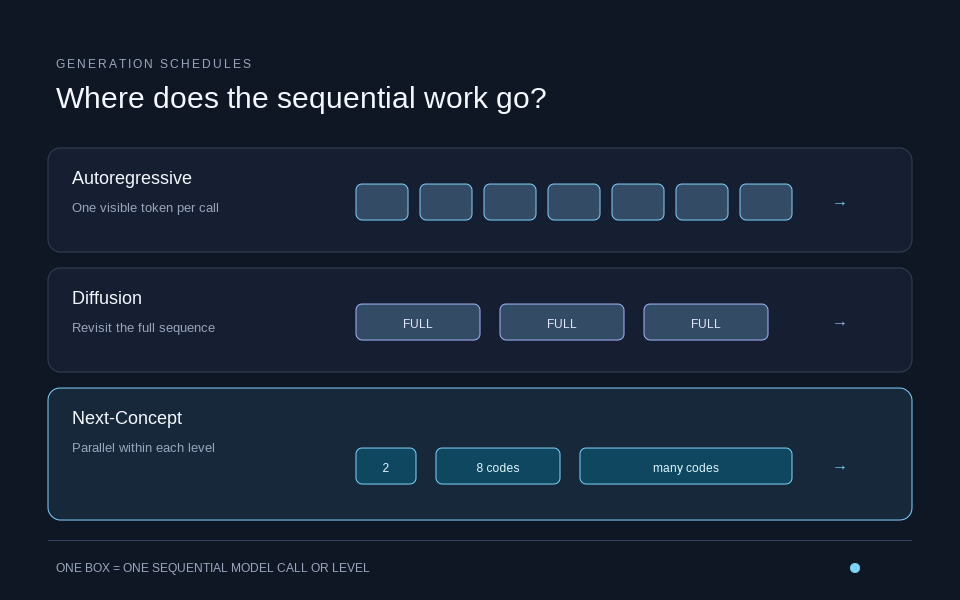
A conventional language model writes a sentence like a careful typist: one token after another. The next choice depends on everything already written. That dependency makes the output easy to stream, but it also creates a long chain of sequential model calls. A diffusion language model can work on many positions together, yet typically revisits the whole sequence repeatedly.
Next-Concept Modeling (NCM) changes the unit of progress. It first learns several increasingly detailed descriptions of a text. At generation time it predicts the shortest, broadest description, then progressively longer descriptions. Every position within one level is predicted in parallel. The number of serial steps is the number of levels, rather than the number of output tokens.
The word concept is deliberately broad here. These are learned discrete codes, not a human-written outline or a guaranteed semantic parse. The early codes often carry global information; later codes repair what the earlier representation cannot express.
First, learn a hierarchy that can reconstruct text
NCM has two separately trained parts. The first is a multiscale residual vector-quantized autoencoder. Its encoder turns a fixed-length text sequence into several code arrays. The first array is short. Each later array is longer, until the last has one code position per original token position. Each scale has its own codebook: a finite set of learned vectors indexed by integers.
The decoder rebuilds text from the combined code vectors. At each scale, the tokenizer selects codes for the information still missing from the reconstruction. In that sense, later arrays represent residual detail. The model upsamples the current representation before adding the next level, so broad information can influence many fine positions.
This tokenizer must be unusually accurate. A slightly blurred image may still be recognizable, but one changed name in a summary or one wrong Sudoku digit can change the answer. The researchers train it with a token-level reconstruction objective and nested dropout, which makes it reconstruct from partial hierarchies during training. That encourages the early levels to carry useful information rather than relying entirely on the final level. On held-out data, the full hierarchy recovers 99.99% of OpenWebText tokens, 99.86% of LM1B tokens, and 98.79% of WMT14 translation tokens; the Sudoku tokenizer reaches 100% in the reported test. Those are reconstruction measurements, not end-to-end generation accuracy.
After this stage, the tokenizer is frozen. The second part, a transformer, learns to predict its codes. The separation makes the task concrete: given a partial reconstruction, which codebook entries should come next?
Generate one scale at a time
Generation starts from an empty representation. The transformer predicts every code in the first, short level at once. Those code vectors form a rough reconstruction. NCM resizes that reconstruction to the next level’s length, predicts all codes there in one call, and adds their vectors. This repeats until the last level. Finally, the frozen decoder converts the completed representation into token distributions and selects output tokens.
The important conditional structure is: level k depends on the reconstruction from levels before k, while positions inside level k can be sampled together. A 128-token output might therefore require a dozen sequential level calls instead of 128 token calls, although later calls process longer arrays. Early calls are particularly cheap because they work on few positions.
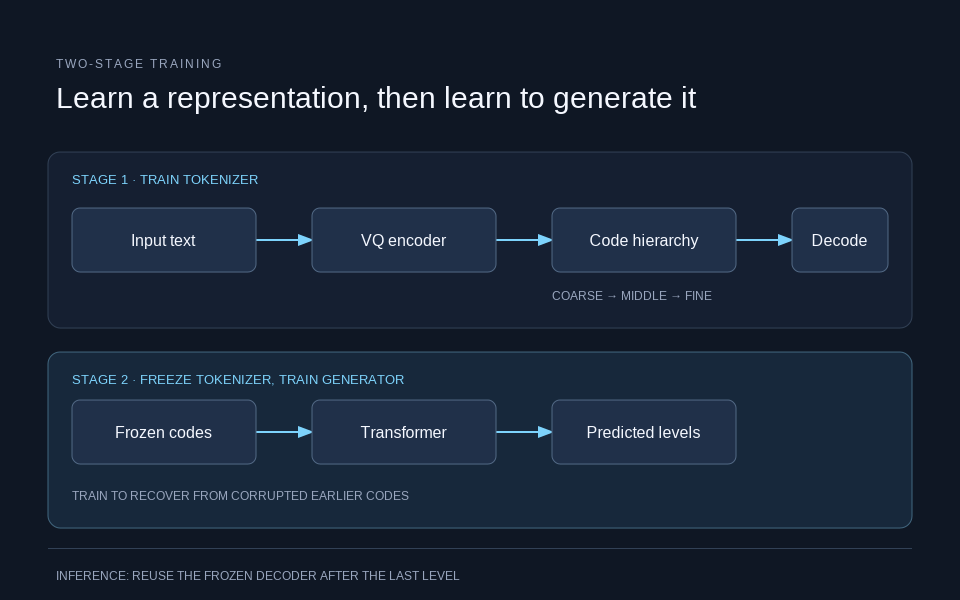
There is a training problem hidden in this loop. During training, the transformer can see code histories derived from real text. During generation, it must condition on codes it predicted itself, including mistakes. NCM deliberately replaces some conditioning codes with random entries from the same codebook during training, while keeping the correct target labels. This teaches the generator to recover from imperfect earlier levels. Too much corruption would erase useful context; the paper reports an ablation showing that moderate corruption helps and excessive corruption hurts.
Training predicts targets at all levels in one forward pass. Inference still advances level by level because each level needs the reconstruction produced by the previous one. Those are different costs and should not be conflated.
Prompts and tasks
For conditional generation, NCM uses a prefix attention pattern. The source text or prompt occupies a prefix; target positions can attend to that prefix and their own block, while the prefix cannot look into the target. The same coarse-to-fine machinery can then translate German to English, write an XSum summary, or continue text from a prompt.
Sudoku is a useful stress test because a correct board depends on constraints across distant cells. NCM generates a representation of the whole board and refines it. That does not prove a general reasoning advantage, but it tests whether this generation order can maintain global consistency in one controlled setting.
The project publishes code, model weights, and tokenized data. Each released model pairs a frozen tokenizer with a generator, reflecting the two-stage design.
What the measurements actually say
The paper’s experiments compare models of roughly similar size on TinyStories, LM1B, OpenWebText, XSum, WMT14 German–English translation, and Sudoku. The quality measure depends on the task: generative perplexity and sample entropy for open-ended generation, ROUGE for summaries, BLEU for translation, and completely solved boards for Sudoku.
On LM1B, NCM attains better generative perplexity than the strongest diffusion baseline used in that comparison, DUO, with 11 times fewer generator evaluations and 21 times lower measured wall-clock generation time. On OpenWebText, it is about 10 times faster at comparable perplexity. For XSum, its unguided 88-million-parameter generator scores 28.0 ROUGE-L in eight evaluations, compared with 26.6 for AURORA-LM in 128 evaluations; the authors also report comparable ROUGE-L at 31 times lower wall-clock time. These timings were measured on a single NVIDIA H100 SXM 80 GB GPU, at batch size 16 in the paper’s end-to-end timing setup. They are benchmark results, not a universal speed claim for every prompt or deployment.
Translation gives a useful counterexample to a simple victory narrative. NCM scores 22.6 BLEU with 11 evaluations on WMT14 German–English. The E2D2 diffusion baseline scores 24.8 with 64 evaluations. NCM trades some raw translation score for fewer serial calls. When it spends more compute generating candidates and selecting one by minimum Bayes risk, its BLEU rises to 25.2 at 132 evaluations. Similarly, candidate selection can raise XSum ROUGE-L to 29.6, but costs 128 evaluations. The speed advantage can be spent on quality, or retained as latency savings.
On the hard Sudoku set, NCM solves 86.1% of boards with 12 evaluations. The strongest reported baseline in that table, FMLM+, solves 81.3% with 16. The easier sets show 99.5% and 96.5% for NCM. This is evidence for the method on the paper’s puzzle distribution, not evidence that the model solves arbitrary mathematical problems.
The authors also count training exposure. On LM1B, the tokenizer and generator together process 13.36 billion full-length token positions, versus about 66 billion for the diffusion baselines, a 4.9-fold difference. This measure counts repeated data exposure; it is not a comparison of total training FLOPs.
Where the design still has friction
The hierarchy depth and each level’s length are fixed. Even a simple or short answer traverses all configured levels. An adaptive schedule could save work, but it has not been demonstrated here. The tokenizer is trained independently of the generator, so its best reconstruction codes need not be the easiest codes to predict. Joint training might improve that fit.
The headline comparisons are against research-scale baselines, with main generators around 100 million parameters. The paper includes a scaling study up to 725 million parameters on LM1B, but does not establish the same result at frontier chatbot scale. Exact reconstruction is also not perfect on every dataset, and errors in names or facts can matter much more than the aggregate token percentage suggests.
The broader idea is a different schedule for parallelism. Instead of committing to the next visible word, NCM commits to a small latent plan, then spends its remaining steps making that plan more precise. Its results show that a learned hierarchy can make this schedule fast and useful across several tasks. Whether it becomes a practical general-purpose generation path depends on larger-scale tests, better tokenizers, and ways to allocate levels according to the difficulty of each output.