GPT-5.6 and GPT-Live: OpenAI Splits Intelligence from the Interface
OpenAI released two model families this week that look separate at first glance. GPT-5.6 is a new generation of frontier models built for coding, professional work, science, cybersecurity, and agents. GPT-Live is a voice model built to listen and speak at the same time.
The more interesting story is what happens when you put them together.
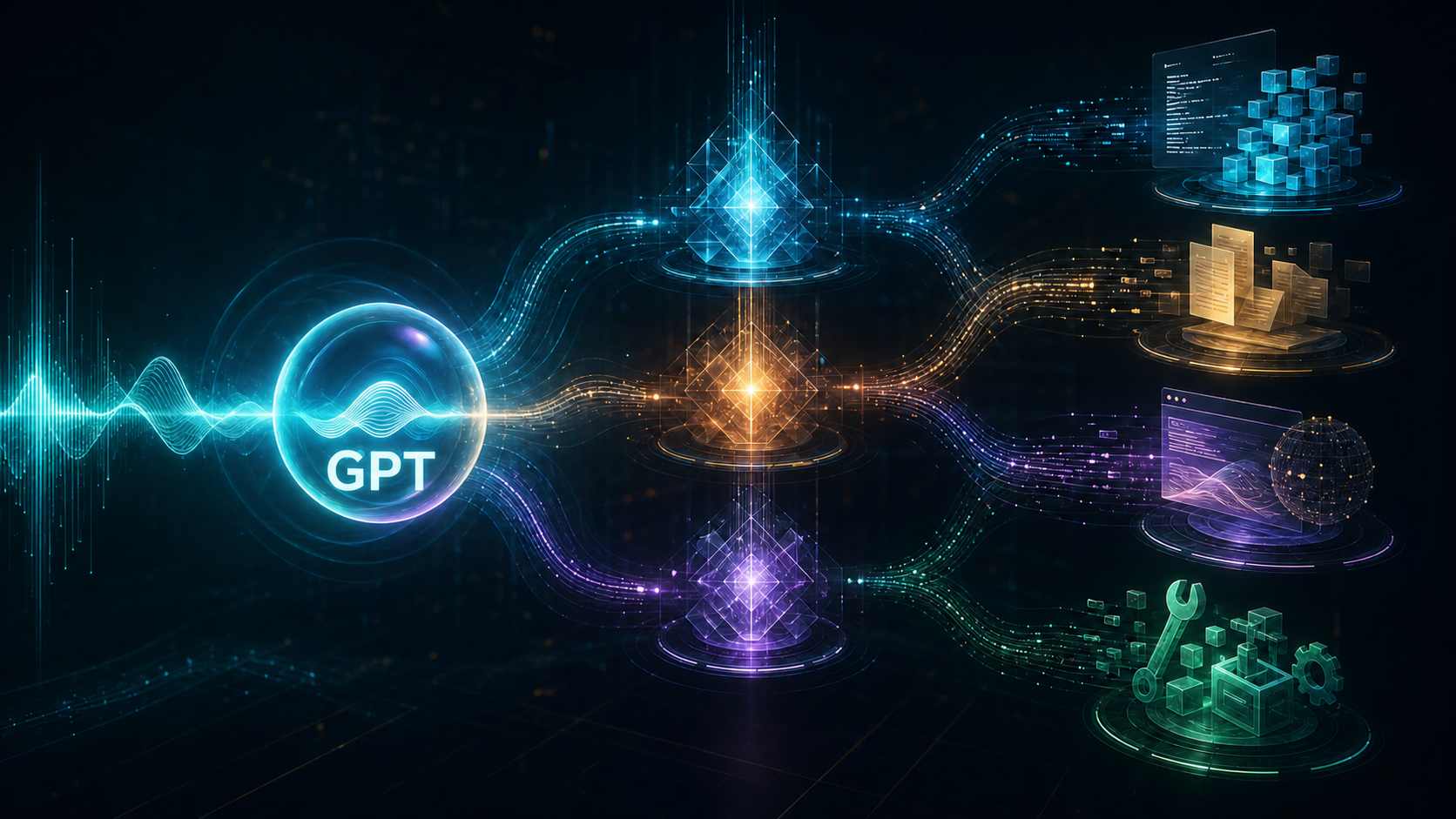
OpenAI is separating the AI that interacts with you from the AI that does the hardest work. GPT-Live can manage a fluid, real-time conversation while delegating search and reasoning to a frontier model in the background. GPT-5.6, meanwhile, can coordinate tools, programs, and even multiple agents to finish complex tasks.
This is not merely a pair of model upgrades. It is a blueprint for AI systems that remain responsive on the surface while becoming much more capable underneath.
GPT-5.6 Is a Family, Not a Single Model
The GPT-5.6 lineup has three durable capability tiers:
| Model | Positioning | Best fit |
|---|---|---|
| GPT-5.6 Sol | Flagship intelligence | Difficult coding, research, professional work, and agents |
| GPT-5.6 Terra | Balanced performance and cost | Everyday production workloads |
| GPT-5.6 Luna | Fastest and most affordable | High-volume and latency-sensitive tasks |
That structure matters. Model selection is becoming less about choosing one universal “best” model and more about matching intelligence to the work. A product can use Luna for routine interactions, Terra for the middle of the distribution, and Sol when failure is expensive or the task is unusually difficult.
OpenAI’s headline claim for the family is more useful work per token. Sol reaches state-of-the-art results across several coding, browsing, computer-use, cybersecurity, and professional-work evaluations. Terra and Luna are positioned to carry much of that capability into cheaper, faster workloads.
The practical advantage is not simply a lower API bill. Token efficiency also affects latency, context pressure, and how long an agent can keep working before its history becomes unwieldy.
Sol Pushes Harder When the Task Justifies It
GPT-5.6 adds two higher-compute modes for difficult problems.
The first is max, which gives the model more time than xhigh to explore alternatives, run checks, and revise its answer. The second is ultra, a mode that coordinates four agents in parallel by default. Instead of asking one model instance to work through every branch sequentially, ultra divides the work and synthesizes the results.
This makes compute allocation more explicit. Routine requests should not pay the same cost as an ambiguous engineering problem, a deep research task, or a multi-stage financial analysis. The system can start efficiently and spend more only when the value of a better result justifies it.
For developers, OpenAI says similar designs can be built through the multi-agent beta in the Responses API. That points toward a future where orchestration is not an application-specific workaround but a standard model capability.
Programmatic Tool Calling Changes the Agent Loop
One of GPT-5.6’s most consequential features may be less visible than its benchmark scores.
With Programmatic Tool Calling, the model can write and run lightweight programs in memory to coordinate tools, filter intermediate results, monitor progress, and decide what to do next. A conventional tool-using agent sends every tool result back through the model. That creates extra round trips and can flood the context window with data that will never affect the final answer.
GPT-5.6 can instead process intermediate information and retain what matters. OpenAI says this can reduce tokens, model turns, and the amount of guidance required for tool-heavy work.
That is an architectural improvement, not just a smarter model. It moves part of the control loop closer to the model and lets an agent behave more like a small adaptive program than a rigid chain of prompts.
Knowledge Work Finally Includes the Last Mile
The GPT-5.6 announcement spends unusual attention on the quality of finished business artifacts. That is important because professional work rarely ends with a correct paragraph. The result has to fit a template, preserve a spreadsheet’s formulas, communicate through a coherent slide deck, or arrive as a document that another person can edit and share.
OpenAI says GPT-5.6 is better at inferring the design system of a reference deck—including layouts, typography, spacing, colors, recurring patterns, and Slide Master rules—and applying it to new material. The same focus extends to documents and spreadsheets, where equations, financial models, hierarchy, and worksheet layout all matter.
This changes the standard by which a model should be judged. A draft that contains the right facts but requires an hour of formatting is not the same product as a ready-to-use deliverable. The last mile is part of the task.
The broader computer-use results reinforce that point. GPT-5.6 Sol reports 62.6% on OSWorld 2.0 and 90.4% on BrowseComp in its single-model configuration, with BrowseComp rising to 92.2% in ultra. Benchmarks are never the whole story, but these target the ability to navigate software and find difficult information rather than merely recall facts.
Coding Is Becoming End-to-End Delivery
OpenAI describes GPT-5.6 Sol as its best coding model yet. The release reports state-of-the-art results on the Artificial Analysis Coding Agent Index, Terminal-Bench 2.1, and DeepSWE.
But the more meaningful shift is in the scope of the work. GPT-5.6 is designed to inspect live systems, use tools, change code, validate the result, and produce a finished artifact. Its stronger computer-use and design judgment also let it examine a rendered interface instead of stopping after it generates source code.
That closes an important loop:
- Interpret the product intent.
- Build the implementation.
- Run and inspect it.
- Notice visual or functional problems.
- Refine the result before handing it back.
For frontend development, the ability to judge the rendered output is as important as generating syntactically correct code. A component can compile and still have broken hierarchy, awkward spacing, poor mobile behavior, or an unusable interaction.
Cybersecurity and Science Raise the Stakes
GPT-5.6 is also OpenAI’s strongest cybersecurity model so far. The reported gains are substantial: Sol scores 73.5% on ExploitBench 2 compared with GPT-5.5’s 47.9%, and 71.2% on SEC-Bench Pro compared with 45.8%. On ExploitGym 3, its two-hour pass rate rises from GPT-5.5’s 15.1% to 24.9%, reaching 33.7% when allowed six hours.
Those abilities are dual-use. The same model that can reproduce a vulnerability can help a defender review code, validate a patch, model threats, or improve detection. OpenAI is reserving more sensitive defensive capabilities for verified users through its Trusted Access for Cyber program, with identity and account-security requirements attached.
Scientific work is another major target. OpenAI reports improvements across genomics, quantitative biology, life-science research workflows, and medicinal chemistry. The company also says GPT-5.6 is being used internally to debug research systems, optimize kernels and training recipes, run experiments, and interpret results.
These domains make reliability and oversight more important, not less. A higher benchmark score does not remove the need for authorization, domain expertise, reproducibility, and human review. It raises the ceiling of what a well-governed team can attempt—and the cost of deploying the system carelessly.
GPT-Live Removes the Turn-Taking Tax
While GPT-5.6 expands what AI can do, GPT-Live changes how it feels to use.
Traditional voice assistants are usually built as a pipeline: speech becomes text, a language model generates a response, and text becomes speech again. More recent audio models reduced that delay, but they still tended to operate in discrete turns. The system waited for silence, assumed the user had finished, and then replied.
GPT-Live uses a full-duplex architecture. It continuously processes input while producing output, allowing it to decide many times per second whether to listen, speak, pause, interrupt, acknowledge the user, or call a tool.
That enables small behaviors that matter enormously in conversation:
- Waiting when someone pauses to think
- Accepting an interruption without losing the thread
- Giving a brief acknowledgement without taking over the conversation
- Staying quiet when asked to listen
- Focusing on the speaker amid background noise
- Performing live translation with more natural timing
These details make voice feel less like submitting audio prompts and more like sharing a live conversational space.
Fast Conversation, Deep Work in the Background
GPT-Live’s key design decision is to separate continuous interaction from deeper reasoning.
When a request needs web search, extended reasoning, or agentic work, GPT-Live delegates it to a frontier model. At launch, GPT-Live-1 uses GPT-5.5 Instant for fast requests, while its Medium and High settings use GPT-5.5 Thinking. The background model can change as OpenAI releases newer frontier systems.
Meanwhile, GPT-Live can keep the conversation moving.
This solves a fundamental tension in voice AI. Human conversation expects immediate feedback, but hard problems need time. Making the conversational model perform every difficult task itself either weakens the answer or creates an uncomfortable silence. Delegation allows the interface to remain responsive while another model searches, reasons, or acts.
It is easy to imagine GPT-5.6 and its successors filling that background role: Sol for the hardest requests, Terra for balanced everyday work, and Luna where speed and cost dominate.
GPT-Live Is More Than Faster Speech
The launch includes two versions: GPT-Live-1 and GPT-Live-1 mini. OpenAI’s human evaluations compare them with Advanced Voice Mode across conversations lasting five to ten minutes, measuring overall preference, turn-taking, interruptions, flow, and naturalness. The company reports a strong preference for both new models.
Capability improved alongside conversational timing. GPT-Live-1 outperforms Advanced Voice Mode in OpenAI’s reported evaluations for expert scientific reasoning, agentic browsing, and realistic multi-turn telecom support. That combination matters because pleasant speech without useful answers is only a better voice skin; intelligence without conversational timing is still awkward to use.
ChatGPT Voice also gains visual response cards for information such as weather, stocks, sports, and maps while the conversation continues. Search, memory, images, and file uploads remain available. Voice is therefore becoming one input and coordination surface inside a multimodal product, not an isolated audio mode.
OpenAI says more than 150 million people use ChatGPT Voice and Dictation each week. At that scale, improvements to interruption, silence, accent coverage, and safety affect far more than a technical demo.
Two Releases, One Architecture
Together, GPT-5.6 and GPT-Live suggest a layered design for the next generation of AI applications:
| Layer | Responsibility |
|---|---|
| Interaction model | Maintains timing, attention, tone, interruption, and conversational context |
| Reasoning model | Handles analysis, search, planning, and difficult decisions |
| Agent runtime | Coordinates tools, programs, computer use, and parallel workers |
| Safety system | Monitors the interaction and applies safeguards during execution |
The user does not need to see those boundaries. They can simply ask a question, continue talking, and receive the result when it is ready. Underneath, the system can route work to different models and spend different amounts of compute based on the task.
This is closer to how effective human teams operate. The person in the conversation does not have to personally perform every analysis. They maintain context, delegate specialized work, and bring the answer back into the discussion.
Safety Has to Operate in Real Time
GPT-Live introduces risks that do not appear in the same way in text. A voice model speaks continuously, can influence an emotionally charged conversation through tone and timing, and may need to change direction before it finishes an unsafe response.
OpenAI says it expanded testing with audio-native and synthetic evaluations covering self-harm, psychosis and mania, emotional reliance, violence, and sexual content. The system can intervene while speech is being generated: steering toward a safer response, presenting support resources, or ending a higher-risk voice conversation. Teen protections and parental controls are also part of the rollout.
The model uses predefined ChatGPT voices and includes safeguards against impersonating a real person. OpenAI is also monitoring emotional reliance after launch, acknowledging that the social effects of a more natural voice system cannot be settled entirely in pre-release tests.
GPT-5.6 uses its own layered safety system, combining model training, real-time checks, monitoring, and account-level enforcement. OpenAI reports roughly 700,000 A100-equivalent GPU hours of automated black-box red teaming before general availability. The company says the models do not cross its Critical capability threshold in either biology or cybersecurity, though Sol’s cyber safeguards intentionally begin more conservatively and may create friction for benign users.
The common principle is that safeguards can no longer sit only at the input and output boundaries. When models speak, browse, write programs, use computers, and delegate work, safety has to observe the process while it unfolds.
Availability and Cost
GPT-5.6 is rolling out across ChatGPT, Codex, and the OpenAI API. API pricing per one million tokens is:
| Model | Input | Output |
|---|---|---|
| GPT-5.6 Sol | $5.00 | $30.00 |
| GPT-5.6 Terra | $2.50 | $15.00 |
| GPT-5.6 Luna | $1.00 | $6.00 |
GPT-Live is rolling out globally across ChatGPT on iOS, Android, and the web. GPT-Live-1 is becoming the default voice model for Go, Plus, and Pro users, while GPT-Live-1 mini is becoming the default for Free users. OpenAI says API access is planned, but it is not available at launch.
There are also launch limitations. GPT-Live does not initially support voice conversations with video or screen sharing, and fluency may vary by language. Legacy voice modes remain available for features the new model does not yet support.
What Developers Should Take Away
The biggest lesson is not “always use the most powerful model.” It is to design products around routing and delegation.
- Use a fast interaction layer to keep the experience responsive.
- Escalate difficult work to a stronger reasoning model.
- Use parallel agents only when the task benefits from the additional compute.
- Process noisy tool output before placing it back into model context.
- Validate artifacts in the environment where users will experience them.
- Treat latency, token use, and result quality as one optimization problem.
The model is becoming one component in a larger intelligent system. The quality of that system increasingly depends on how well it decides who should do the work, how much effort to spend, and when to return control to the user.
The Bottom Line
GPT-5.6 makes frontier intelligence more scalable across different budgets and levels of difficulty. GPT-Live makes access to that intelligence feel immediate and conversational. One advances the engine; the other redesigns the steering wheel.
The combination points beyond chatbots that wait for a prompt and produce a single response. The emerging pattern is a continuously available interface backed by a dynamic team of models, tools, and agents—responsive enough for natural conversation and powerful enough for serious work.