
How Python Workers Turn CPython into an Edge Runtime
Putting Python in a serverless function sounds straightforward until the function is expected to start quickly, run inside a strict sandbox, access platform services, import packages with native extensions, and behave like the Python developers already know.
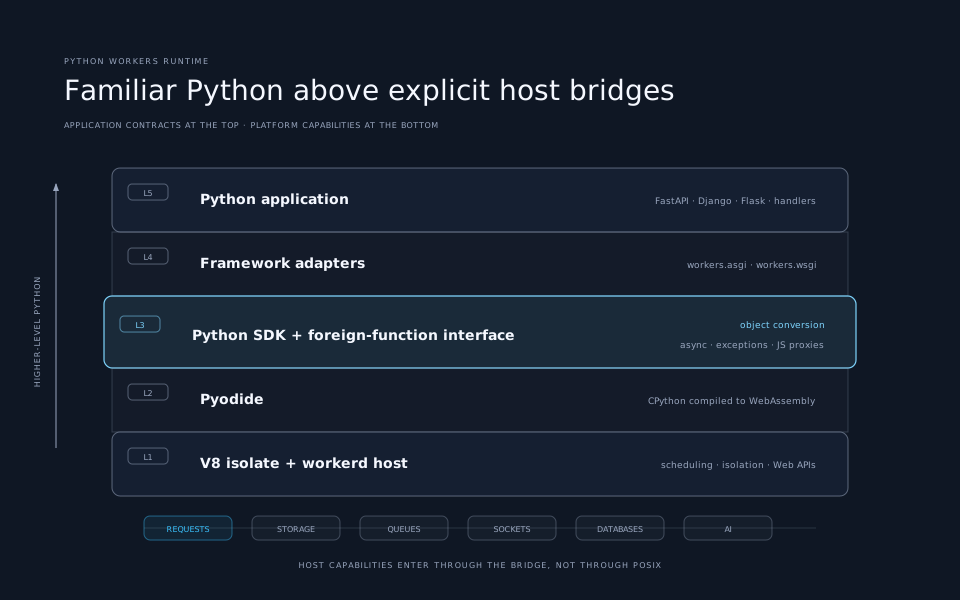
Cloudflare’s generally available Python Workers do not solve this by hiding a Linux container behind a Python API. They run Pyodide—a port of CPython compiled to WebAssembly—inside the same V8 isolate architecture used by JavaScript Workers. The platform then supplies the missing connections between that WebAssembly guest and the surrounding Workers runtime.
That distinction explains both the appeal and the limits. This is real CPython, but it is not CPython on a conventional operating system. The filesystem is temporary, process-oriented modules do not become useful merely because they import, and networking ultimately crosses into JavaScript runtime primitives. The system works because Cloudflare has moved expensive work out of the request path and built deliberate bridges at the boundaries developers use most.
The runtime is CPython inside an isolate
Pyodide compiles CPython and a growing package ecosystem for WebAssembly through Emscripten. In a Python Worker, the WebAssembly instance lives inside a V8 isolate managed by workerd, Cloudflare’s open-source Workers runtime. Python source is interpreted by CPython; the surrounding isolate supplies scheduling, requests, platform APIs, and isolation.
A minimal Worker still looks like ordinary event-driven serverless code:
from workers import Response, WorkerEntrypoint

class Default(WorkerEntrypoint):
    async def fetch(self, request):
        return Response("Hello from Python")
There is no listening socket in this program. fetch() is the entry point selected by the platform for an incoming request. Request and Response originate in the JavaScript runtime and are exposed to Python through Pyodide’s foreign-function interface and Cloudflare’s Python SDK.
This design avoids running a separate Python service beside the isolate, but it creates a stack of translation boundaries. Python objects may need to become JavaScript values. Framework requests must become ASGI or WSGI scopes. A Python socket call has to become a Workers connect() operation. An HTTP library eventually has to use fetch(). General availability is less about making the interpreter boot and more about making those boundaries feel unsurprising.
Cold starts are turned into a deployment problem
Starting CPython, importing a framework, loading packages, and executing top-level module code can be costly. Repeating all of that when an isolate is created would put Python at a structural disadvantage against a small JavaScript handler.
Cloudflare’s answer is to pay much of that cost when the application is deployed. According to the Python Workers lifecycle documentation, deployment uploads the source and dependencies, selects the Pyodide version from the compatibility date, creates an isolate, injects Pyodide, imports the entry module, and runs its top-level initialization. The runtime then snapshots the resulting WebAssembly linear memory.
That snapshot travels with the Worker. When a request needs a new isolate, the platform restores initialized memory instead of reconstructing the interpreter and replaying every import from zero. The request still has work to do, but interpreter setup and stable module initialization have been shifted onto the release path.
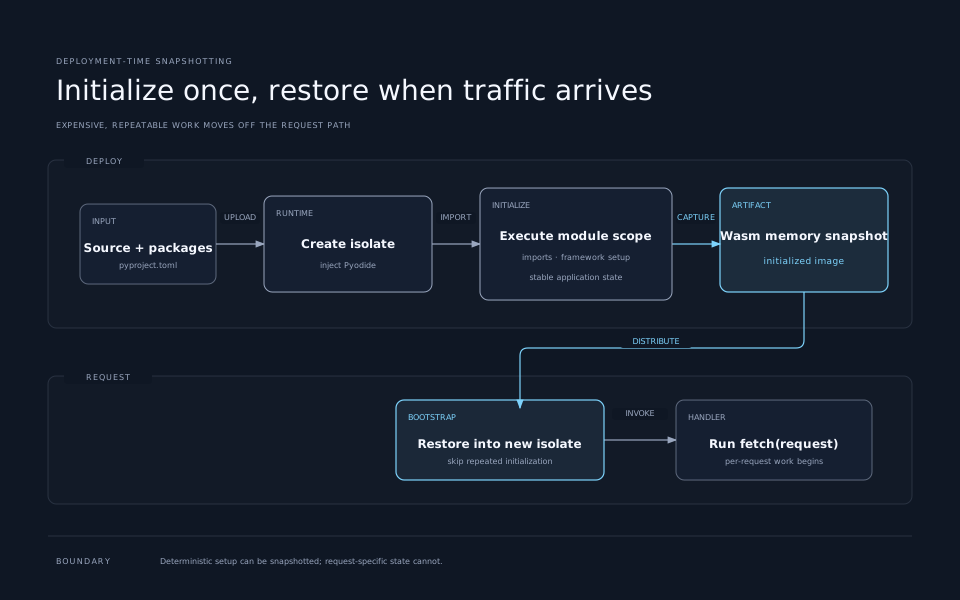
This changes how application authors should think about module scope. Deterministic setup that every isolate needs belongs at import time and can benefit from snapshotting. Per-request state, credentials that rotate independently, and data that must never be shared across requests still belong in the request path or in platform storage.
Snapshots also make version selection important. Cloudflare couples Pyodide and Python runtime changes to Workers compatibility dates and flags. A deployed Worker does not silently jump to every new interpreter behavior. Teams gain stability, but they must test compatibility-date upgrades as real runtime upgrades rather than treating the date as decoration.
Bindings are Pythonic instead of JavaScript-shaped
Workers applications usually reach storage and services through bindings: R2 buckets, D1 databases, KV namespaces, Queues, Durable Objects, Workflows, Workers AI, Vectorize, Hyperdrive, secrets, and service bindings. Early Python Workers could access them through Pyodide’s JavaScript interoperability layer, but application code often had to perform conversions explicitly.
Sending a dictionary to a Queue, for example, previously required converting the Python mapping into a JavaScript object with pyodide.ffi.to_js. The GA runtime and SDK encapsulate that conversion, so application code can pass the dictionary directly:
await self.env.QUEUE.send({"kind": "thumbnail", "object": "images/42"})That short line carries an important architectural promise: Python developers should be able to use platform bindings without keeping a shadow JavaScript program in their heads. The conversion layer owns routine marshaling, while the foreign-function interface remains available when direct access to JavaScript objects or globals is useful.
The boundary cannot disappear completely. JavaScript and Python have different ownership rules, type systems, exception behavior, and async machinery. Passing large or deeply nested values can still have conversion costs. APIs exposed through proxies can preserve different identity or lifetime semantics than native Python objects. The SDK’s job is not to pretend the languages are identical; it is to make the common path safe and idiomatic.
Framework support removes the inner web server
FastAPI, Starlette, Django, and Flask were designed around standard application protocols rather than a specific server implementation. ASGI describes asynchronous calls and event messages. WSGI describes a synchronous callable receiving an environment and a response callback. Uvicorn, Gunicorn, or another server normally converts sockets and HTTP into those protocols.
Inside Workers, the outer platform already terminates HTTP, distributes traffic, and invokes an isolate. Starting another network server would duplicate work and conflict with the sandbox. Cloudflare instead provides workers.asgi and workers.wsgi adapters:
from fastapi import FastAPI
from workers import asgi

app = FastAPI()

@app.get("/health")
async def health():
    return {"ok": True}

Default = asgi.entrypoint(app)
The adapter translates a Workers request into the scope and messages the framework expects, then converts the framework response back to the runtime. The application remains organized around familiar routing, middleware, validation, and dependency patterns; the platform replaces the process manager and listening server.
This is portability at the protocol boundary, not binary portability of an entire deployment. A framework application that assumes a writable persistent disk, subprocesses, threads, Unix signals, or a resident local daemon will still need redesign. The adapters preserve the web contract, not the surrounding Linux machine.
Networking works by translating the bottom of the stack
Database clients made the WebAssembly boundary especially visible. Drivers such as asyncpg and aiomysql eventually call Python’s socket APIs. In a conventional process, those calls become operating-system syscalls. A WebAssembly guest inside an isolate has no ordinary POSIX network stack to call.
Cloudflare implemented the relevant socket behavior on top of the Workers connect() API. A driver can issue familiar operations while the runtime translates them into the host’s outbound TCP capability. That bridge enables Python database drivers to connect through Hyperdrive, which provides the platform binding and connection information.
HTTP libraries take a related path. Packages such as Requests, urllib3, and HTTPX can route outbound work through JavaScript fetch() in WebAssembly environments. This unlocks large parts of the Python AI and API ecosystem, including OpenAI clients, LangChain, and MCP libraries, without each library having to learn Cloudflare-specific application code.
The translation is useful, but it deserves precise testing. A browser-style fetch() backend does not automatically share every observable behavior of a native socket backend. Redirect controls, streaming, connection handling, headers, cancellation, and event-loop scheduling can expose differences. The Hacker News discussion included an urllib3 maintainer pointing to a past redirect-control vulnerability in the Emscripten backend and noting that the backend remains experimental in urllib3’s security policy.
The practical rule is simple: test the behaviors the application depends on, not only whether an import succeeds. Exercise redirects, timeouts, cancellation, streaming bodies, TLS expectations, proxy behavior, and error types. A compatibility layer is part of the production networking stack and should receive the same scrutiny as a conventional transport adapter.
PyEmscripten wheels make packages distributable
Pure-Python packages are the easy case because Python bytecode does not depend on a machine instruction set. Packages containing C, C++, or Rust extensions normally publish platform-specific wheels for targets such as Linux on x86-64 or macOS on ARM64. Those binaries cannot run inside a wasm32 CPython build.
Pyodide has long maintained its own ports, including scientific and general-purpose packages. That proved the ecosystem was possible, but a central project manually building and hosting packages does not scale like normal Python packaging.
PEP 783, accepted in 2026, defines pyemscripten platform tags for binary wheels. A maintainer can build and publish a wheel whose tag describes compatibility with the PyEmscripten ABI and WebAssembly target. Package indexes can recognize the artifact, installers can select it, and projects can test the same distribution model they use for other platforms.
Python Workers now support pure Python packages, PyEmscripten wheels from PyPI, and packages already included with Pyodide. pywrangler resolves and bundles dependencies from pyproject.toml for local development and deployment. This moves WebAssembly Python closer to an ecosystem rather than a curated appliance.
It is not universal yet. Native extensions need an Emscripten-compatible build, and dependencies may assume operating-system facilities unavailable in the sandbox. The platform’s own standard-library documentation excludes modules such as fcntl, resource, termios, tkinter, and venv; multiprocessing and threading may import but are not functional. Files live in an isolate-local, in-memory filesystem and disappear with the isolate.
What general availability does and does not mean
General availability means Cloudflare treats Python as a supported language on the platform, with production-ready bindings, framework adapters, networking, tooling, examples, and documentation. It does not turn the isolate into a general Linux host.
Python Workers fit best when an application is naturally request- or event-driven and its durable state already belongs in external services. Good candidates include APIs, webhook processors, queue consumers, scheduled jobs, AI orchestration, document transforms, and framework applications that can use R2, D1, KV, Durable Objects, or remote databases.
Applications need closer evaluation when they require:
- subprocesses, multiple native threads, or process-level signals;
- arbitrary native wheels without PyEmscripten builds;
- a persistent local filesystem;
- precise native-socket behavior not covered by the compatibility backend;
- long-lived in-process state that must survive isolate eviction;
- libraries that couple their public API to Unix-specific implementation details.
The presence of familiar imports can make these boundaries easy to miss. A disciplined migration starts with the operating assumptions, not the routing code.
A practical evaluation sequence
Before moving an existing service, reduce the uncertainty in layers:
- Run a minimal handler through
pywrangler devand verify local behavior underworkerd, not only in the host Python interpreter. - Add dependencies one group at a time. Confirm that every native extension has a compatible PyEmscripten wheel or Pyodide package.
- Connect one platform binding and inspect type conversion, error behavior, payload limits, and cancellation.
- Add the ASGI or WSGI adapter, then run the framework’s integration tests without its conventional server.
- Test outbound HTTP and database edge cases, including redirects, timeouts, streaming, transactions, and reconnects.
- Move persistent files and cross-request state to explicit storage.
- Benchmark startup and steady-state latency with realistic imports, because dependency shape matters more than a hello-world number.
- Pin and review the compatibility date as part of normal runtime upgrades.
This sequence isolates which promise is being tested: CPython compatibility, package availability, host interoperability, framework adaptation, or operational fit.
The larger engineering lesson
Python Workers are a useful example of platform engineering through boundary design. Compiling an interpreter to WebAssembly provides portability and isolation, but it does not by itself provide a pleasant application platform. Developers experience the seams: startup, objects crossing languages, framework protocols, sockets, package formats, files, and version upgrades.
Cloudflare’s work is concentrated at those seams. Snapshotting moves repeatable initialization to deployment. The SDK owns common object conversions. ASGI and WSGI adapters reuse established framework contracts. Socket and fetch bridges translate networking at a low layer. PyEmscripten tags let the packaging ecosystem distribute the right binaries.
The result is not Python pretending to be JavaScript, and it is not a container disguised as a function. It is CPython running as a WebAssembly guest whose host integrations have been made explicit enough that ordinary Python patterns can cross the boundary.
Sources
- Cloudflare, Python Workers are now generally available
- Cloudflare documentation, How Python Workers Work
- Cloudflare documentation, Python packages
- Cloudflare documentation, Python Workers FFI
- Cloudflare documentation, Python standard library
- Cloudflare Python Workers examples
- Pyodide documentation
- PEP 783, Emscripten Packaging
- Hacker News discussion