Every Review Layer Multiplies Latency: How Teams Get Slower and How to Recover
Most engineering teams still think in terms of coding speed: better IDEs, better prompts, better models, better scaffolds. But once you look at delivery time end to end, that is usually not where your latency lives.
The real drag is queueing: waiting for review, waiting for approval, waiting for another team’s calendar, waiting for risk sign-off, waiting for someone senior enough to bless a direction. Coding gets faster while delivery stays slow, and the difference is process latency.
A useful rule of thumb is blunt but surprisingly predictive:
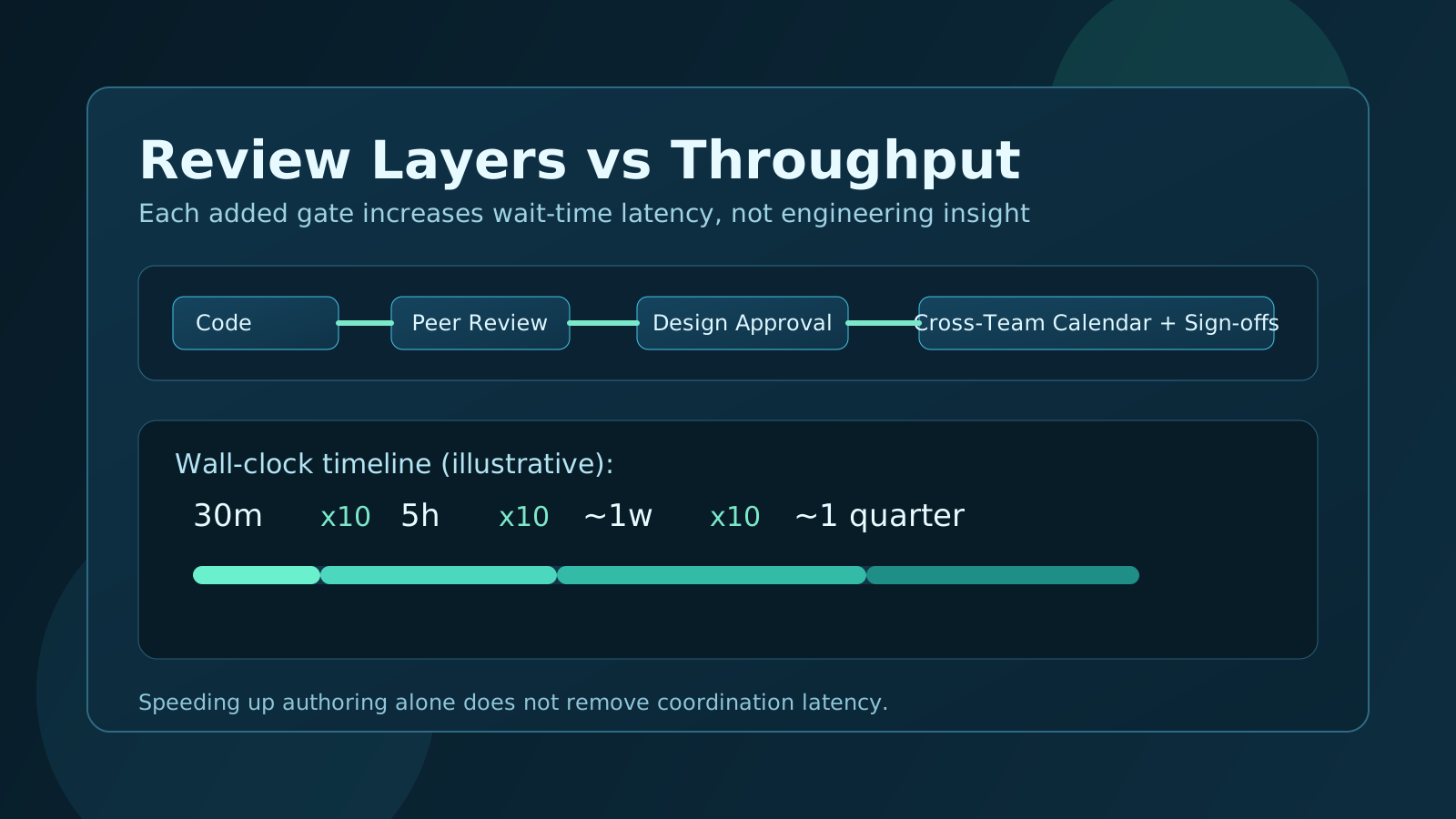
Every extra approval layer can make wall-clock delivery roughly 10x slower.
Not 10% slower. Not 2x slower. Often 10x slower at each layer once handoffs, scheduling, and async feedback loops are included.
That sounds exaggerated until you model real timelines.
The Math That Feels Wrong but Matches Reality
Imagine a straightforward bug fix.
- Write and test locally: about 30 minutes.
- Add one peer review loop: now it lands in a queue, gets comments, gets revised, rechecked. Around 5 hours wall clock is common.
- Add architecture review as a mandatory gate: now your change rides meeting cadences and document cycles. You are at about a week.
- Add cross-team dependency, product planning, or external stakeholder scheduling: one quarter disappears quickly.
The work itself did not scale by 10x each time. Waiting did.
That distinction matters. Teams often optimize labor minutes while their bottleneck is elapsed time.
Why AI Speedups Hit a Wall
AI tools are excellent at the first segment of the pipeline: producing draft code quickly. That gain is real.
But if the rest of the pipeline is unchanged, the win gets absorbed by downstream queues.
- A 30-minute coding task becoming a 3-minute task does not remove a 5-hour review queue.
- A week-long feature compressed into a day still has to pass design, risk, and integration gates.
- A larger AI-generated patch can actually slow review because confidence is lower and reviewers inspect more defensively.
So the paradox appears: output volume goes up while shipping throughput barely moves.
This is where many teams get trapped. They experience local acceleration, then mistake it for system acceleration.
The Typical Failure Spiral
When review capacity becomes the bottleneck, teams often improvise with more automation on top of the same structure.
The loop looks like this:
- Generate code faster.
- Hit defects and regressions.
- Add more review steps and guardrails.
- Add more agents to produce and inspect more code.
- Increase orchestration complexity.
- Ship no faster than before, with higher cognitive load.
It feels like progress because activity increases. But activity is not throughput.
Why We Added All These Reviews in the First Place
Review layers are not irrational. They emerged to control risk.
At scale, one bad release can erase the value of many good ones. So organizations add checks:
- code review,
- architecture review,
- security review,
- reliability sign-off,
- product/legal approvals,
- release process gates.
Each layer lowers some risk. But each layer also adds queueing delay and diffuses ownership. Over time, teams can drift into an inspection-heavy system where defects are “caught later” instead of prevented earlier.
That tradeoff eventually breaks down.
Inspection-Heavy Systems Create Perverse Incentives
In manufacturing terms, this is the classic over-reliance on Quality Assurance as a downstream filter.
If quality is mostly enforced by late-stage inspection, behavior shifts:
- Builders rely on inspectors to catch defects.
- First-line reviewers assume second-line reviewers will catch misses.
- Later-stage reviewers inherit noisy, oversized changes and become overloaded.
- Everyone optimizes for passing the gate, not for reducing defect injection.
You can stack inspectors and still ship fragile systems because root causes remain intact.
Inspection can detect defects. It does not automatically eliminate the conditions that produce them.
Quality Comes From Design, Not Gate Count
If the goal is both speed and reliability, the lever is not “more layers.” The lever is making defects harder to create and easier to detect automatically at source.
That means moving from review-as-filter to quality-by-construction.
Examples:
- Strong typing and explicit contracts at boundaries.
- Opinionated formatters and linters that erase entire classes of review comments.
- Deterministic tests in CI with stable fixture isolation.
- Fast integration tests that run by default, not as special events.
- Production guardrails (feature flags, canaries, automatic rollback thresholds).
- Tight module interfaces that constrain blast radius.
The key mindset shift:
A great reviewer does not just leave comments. A great reviewer helps eliminate the need for that same comment forever.
When a class of review feedback disappears system-wide, throughput rises without lowering standards.
Trust Is the Hidden Variable
Reducing review layers without trust creates chaos. Keeping all review layers because trust is absent creates paralysis.
Healthy high-velocity teams build trust in three directions:
- Individual to team: people are expected to stop the line on defects, not hide them.
- Team to leadership: surfacing risk is rewarded, not punished.
- Leadership to system: quality metrics and incident learning are used to improve design, not to assign blame theater.
Without this, no process change sticks.
Practical Blueprint for Faster, Safer Delivery
You do not need a dramatic reorg. You can migrate incrementally.
-
Map your latency, not just your effort. Measure median and p95 time in each stage: authoring, review queue, rework loop, approvals, deploy.
-
Identify one repeat review class to automate away. Pick something frequent and mechanical. Codify it in tooling or tests.
-
Shrink PR size aggressively. Small changes reduce reviewer load, queue time, and rollback cost.
-
Replace one synchronous gate with asynchronous evidence. For example, require a deterministic test suite + ownership checklist instead of a calendar meeting.
-
Tighten module boundaries. Smaller ownership surfaces reduce coordination overhead and let teams ship independently.
-
Run blameless postmortems focused on root cause removal. “The engineer missed it” is a symptom, not an explanation.
-
Track quality and speed together. Lead time, change failure rate, MTTR, and escaped defects must be observed as one system.
Modularity Is a Throughput Strategy
As systems grow, team structure matters as much as code structure.
When small teams own clearly defined modules, they can iterate quickly with local trust and local quality loops. Coordination becomes interface-level, not constant full-graph synchronization.
This is also where AI can help most safely:
- accelerating implementation inside a bounded module,
- generating tests and migration scaffolds,
- assisting refactors that preserve contracts.
In other words, use AI to compress execution inside stable boundaries, not to spray unbounded change across the entire organization.
The Real Constraint Is Organizational Latency
The future of software speed is not just better code generation. It is better systems design for decision flow, quality ownership, and boundary management.
If your process still depends on piling review layers onto every change, coding faster will not save you. You will only arrive at the same bottleneck sooner.
If instead you remove preventable defect classes, shorten feedback loops, and build trust-backed quality systems, you can ship faster and safer.
That is the hard part. It is also the only durable one.