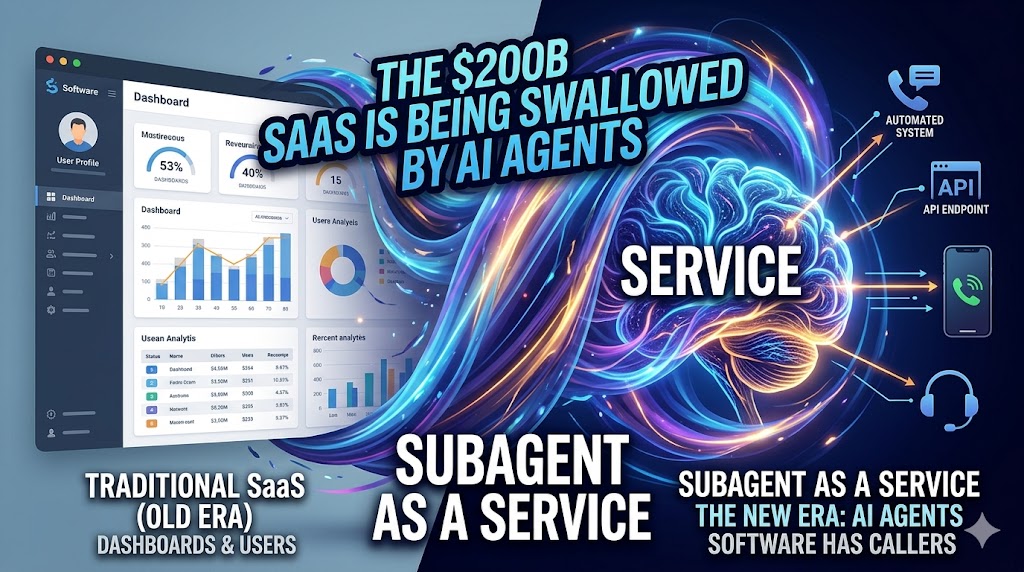
SaaS Is Dead. Long Live SaaaS (Subagent as a Service)
There’s a quiet revolution happening in enterprise software, and most people haven’t noticed yet.
Every major SaaS company is racing to bolt AI features onto their existing products. Salesforce has Einstein. HubSpot has Breeze. Notion has Notion AI. They’re all adding chatbots, co-pilots, and “AI-powered insights” to dashboards that humans still click through manually. And they’re all missing the point entirely.
The real shift isn’t adding AI to software. It’s software becoming AI. Not a chatbot sitting inside your CRM—your CRM becoming an agent that other agents can call, negotiate with, and delegate work to. No dashboard. No login screen. No human in the loop at all.
Nivedit Jain calls this SaaaS: Subagent as a Service. And once you see it, you can’t unsee it.
The Three Eras of Software Integration
To understand where we’re going, you need to see where we’ve been. Software integration has evolved through three distinct phases, each one removing a layer of human friction.
The SaaS Era (2000–2015) gave us cloud dashboards. Humans logged into Salesforce, manually exported CSV files, imported them into another tool, and called it “integration.” It worked, but only because humans were the glue holding everything together.
The API Era (2015–now) replaced humans with machines—at least for data transfer. REST APIs, webhooks, and more recently MCPs let systems talk to each other through fixed schemas. You send a POST request, you get a JSON response. Predictable, reliable, but rigid. Every integration is a custom plumbing job. Every new connection requires an engineer to write and maintain the glue code.
The SaaaS Era (emerging) replaces fixed schemas with natural language negotiation between agents. Instead of calling POST /api/contacts with a predefined payload, an orchestrator agent says to a Salesforce subagent: “Find enterprise accounts showing churn risk based on declining engagement and upcoming renewal dates.” The subagent understands the intent, figures out the execution, and returns outcomes—not raw data dumps.
The difference is profound. APIs return data. Subagents return results.
Companies Don’t Add Agents. They Become Agents.
Here’s the paradigm shift that most people miss: in the SaaaS world, Salesforce doesn’t add an AI chatbot to its CRM. Salesforce becomes a callable CRM agent. The entire company’s domain expertise—decades of understanding customer relationships, sales pipelines, and engagement patterns—gets distilled into a specialized subagent that other agents can invoke.
Think of it like this. Today, api.salesforce.com is an endpoint that returns JSON when you send it structured requests. Tomorrow, agent.salesforce.com is a conversational entity that understands what you’re trying to accomplish and figures out how to accomplish it.
The mental model isn’t “software with an AI feature.” It’s “intelligence as a service.” The dashboard becomes optional. The API becomes a fallback. The primary interface is agent-to-agent conversation.
The Orchestrator Pattern
This naturally creates a two-layer architecture. At the top, you have orchestrator agents—the strategic layer that understands your goals and coordinates across domains. At the bottom, you have specialist subagents—the execution layer that handles domain-specific work.
The orchestrator is your operating system. It takes a high-level objective like “reduce customer churn by 15% this quarter” and breaks it into domain-specific tasks. It routes the CRM analysis to Salesforce’s subagent, payment pattern analysis to Stripe’s subagent, re-engagement campaign execution to HubSpot’s subagent. Each specialist does what it does best. The orchestrator stitches the results together.
What’s interesting is that the orchestrator doesn’t need to know how any of these subagents work internally. It doesn’t care about Salesforce’s data model or Stripe’s webhook format. It communicates in natural language, delegates by intent, and evaluates by outcome. The complexity is encapsulated.
This is the separation of concerns taken to its logical extreme. And it mirrors a pattern we’ve seen before—microservices, but for intelligence rather than computation.
A Concrete Example
Let’s make this tangible. Imagine you’re running Acme Corp and your orchestrator detects a churn risk signal.
Today’s workflow:
- An engineer writes a script that queries the Salesforce API for accounts with declining login frequency
- Another script hits Stripe’s API to check payment patterns
- A third integration pushes at-risk accounts into HubSpot for email campaigns
- Someone builds a dashboard to monitor all this
- A human reviews the dashboard weekly and makes decisions
Six tools, three integrations, two humans, one fragile pipeline that breaks every time an API changes.
Tomorrow’s workflow:
The orchestrator agent notices a pattern and says to the Salesforce subagent: “Identify enterprise accounts showing disengagement signals.” Salesforce returns a prioritized risk assessment. The orchestrator passes relevant context to the Stripe subagent: “Analyze payment patterns for these accounts—any billing friction?” Stripe surfaces three accounts with failed payment retries. The orchestrator tells HubSpot’s subagent: “Execute a win-back sequence for these accounts, prioritized by contract value.”
No API calls. No JSON parsing. No dashboard. No human in the loop until the orchestrator surfaces a decision that needs human judgment.
That’s the difference. From plumbing to delegation. From data pipelines to outcome orchestration.
Four Moats in the SaaaS World
If every company becomes an agent, what makes one agent more valuable than another? Jain identifies four durable competitive advantages:
Ultra-Specialists win by going impossibly deep in narrow domains. Think of a legal-compliance subagent that knows every FDA regulation for medical devices, or a tax subagent that handles international transfer pricing across 40 jurisdictions. The deeper the expertise, the harder it is to replicate. These agents become irreplaceable precisely because their knowledge is so specialized that no orchestrator would attempt to internalize it.
Connectors win by routing. They’re the agents that know which specialist to call for a given problem, that maintain a dynamic registry of available subagents, and that handle the messy work of discovery and negotiation. In a world of thousands of specialist agents, knowing who to call is as valuable as being the one who gets called.
Gatekeepers win by owning proprietary data. Bloomberg’s financial data, Nielsen’s consumer insights, a hospital system’s patient records—these are moats that no amount of AI capability can replicate. The subagent’s value isn’t in its intelligence; it’s in the data that flows through it.
Operators win by executing reliably at scale. When an orchestrator delegates “process 10,000 refunds by end of day,” it needs a subagent that actually gets it done—correctly, on time, every time. Execution at scale is an underrated moat.
The Infrastructure We’re Missing
Here’s the uncomfortable truth: none of this works yet. Not because the AI isn’t capable enough, but because we haven’t built the infrastructure layer. Seven critical primitives are missing:
Full-duplex communication. Today’s APIs are request-response. Agent-to-agent work needs persistent, bidirectional streams where both parties can push information, ask clarifying questions, and negotiate in real time.
Ephemeral authentication. When an agent delegates a task to a subagent, it needs to grant scoped, time-limited access—not hand over permanent API keys. We need auth protocols designed for autonomous actors, not human users.
Autonomous billing. If agents are calling agents, who pays? We need billing systems where agents can commit to outcome-based payments, with escrow mechanisms and dispute resolution—all without human intervention.
Dynamic discovery. How does an orchestrator find the right subagent for a novel task? We need a DNS-like registry for agent capabilities, with real-time availability, reputation scoring, and capability matching.
PII firewalls. When an orchestrator passes customer context to a subagent, how do you ensure sensitive data doesn’t leak? We need protocol-level privacy controls that strip PII before it crosses agent boundaries.
Durable execution. Multi-step agent tasks can take hours or days. We need execution engines that handle retries, checkpointing, and graceful degradation when subagents go down mid-task.
Runtime evaluators. Continuous verification at every step—not just checking the final output, but monitoring every intermediate action. Think of it as watching vitals on every breath, not just checking the pulse at the end.
These aren’t nice-to-haves. They’re load-bearing walls. Without them, the SaaaS vision is science fiction.
The Pricing Revolution
There’s a business model implication here that’s easy to overlook: SaaaS kills per-seat pricing.
When your customer is an agent, not a human, “per user per month” makes no sense. What replaces it is outcome-based pricing. Salesforce’s subagent doesn’t charge per seat—it charges per churn risk identified, per deal closed, per pipeline accurately forecasted. Stripe’s subagent charges per fraud case prevented, per payment retry recovered.
This is terrifying for incumbents because it demands measurable results. You can’t hide behind “platform value” or “ecosystem lock-in” when your customer is an AI that will ruthlessly comparison-shop across competing subagents based on cost-per-outcome. The agent doesn’t care about your brand. It doesn’t attend your user conference. It just wants the best result for the lowest price.
Companies that can prove their outcomes will thrive. Companies that can’t will discover that their “sticky” enterprise contracts become a lot less sticky when the buyer is an optimization algorithm.
The Window Is Closing
If any of this sounds like it’s five years away, look at what’s already happening. Claude, GPT, and Gemini all support tool use and agent-to-agent delegation. MCP is standardizing how models interact with external systems. Companies like Anthropic and OpenAI are building orchestration frameworks. The agent infrastructure race has already started.
The historical pattern is clear. Cloud computing had a roughly three-year window where foundational players (AWS, Azure, GCP) locked in dominance. Microservices had a similar window where Kubernetes, Docker, and the service mesh players established themselves. The SaaaS infrastructure window is open right now, and whoever builds the foundational primitives—the auth protocols, the discovery layers, the billing systems—will be extraordinarily difficult to displace.
What This Means for You
If you’re building a SaaS product, start thinking about what your company looks like as an agent. What’s the domain expertise you’d encapsulate? What outcomes can you guarantee? What data moat do you sit on?
If you’re building infrastructure, the seven missing primitives above are a roadmap. Each one is a potential billion-dollar company.
If you’re a developer, learn to build agents, not just apps. The skills that matter are shifting from “can you build a CRUD interface” to “can you design an agent that reliably accomplishes complex goals across multiple domains.”
The dashboard era gave us SaaS. The API era optimized it. The agent era is about to replace it entirely.
Software that has users is being eaten by software that has callers. The only question is whether you’ll be building the new world or getting disrupted by it.