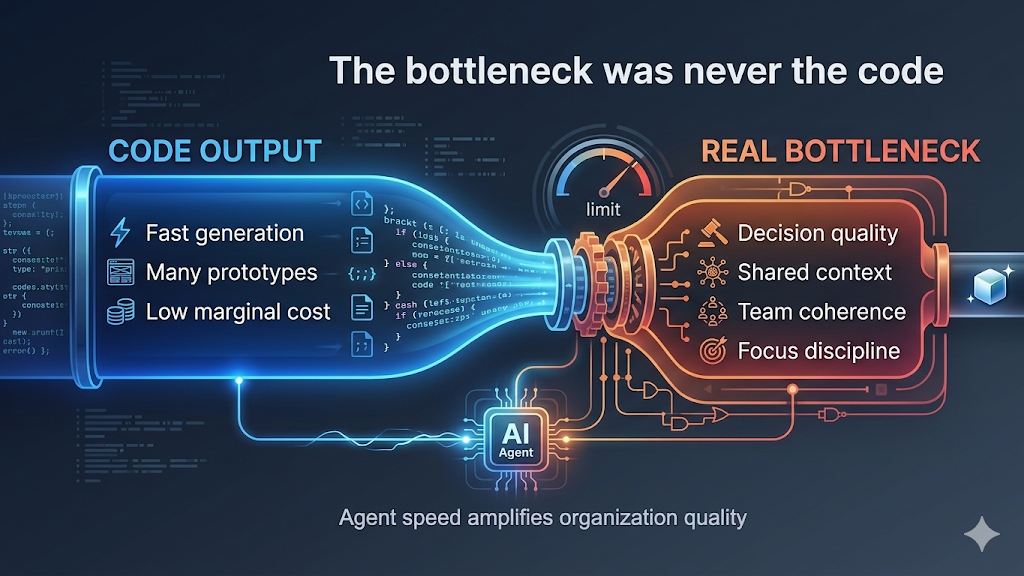
The Bottleneck Was Never Code: An Agent-Era Playbook for Engineering Teams
Code generation is getting cheaper every month, but software delivery does not magically become easy. The thing that gets exposed is what was always hard: deciding what should exist, in what order, with what trade-offs, and with enough shared context that the result is coherent.
The Throughput Shift: From Typing Code to Choosing Code
In many teams, implementation speed is no longer the main limiter for day-to-day product work. A solid prompt, clear constraints, and an agent can produce a first working version quickly.
That does not mean the product ships faster by default.
The critical path often moves upstream:
- Who decides what the next change should be?
- Who writes acceptance criteria that are precise enough to execute?
- Who settles trade-offs between local speed and system consistency?
- Who owns the call when requirements are ambiguous?
When teams say “the model is fast but we are still blocked,” this is usually where the queue lives.
The new queue is specification quality.
Specification Is Now a Production Discipline
When people picture specs, they often imagine heavyweight documents that slow everyone down. That framing fails in the agent era.
A good spec for agentic execution is not bureaucracy. It is a compact control surface that lets the organization convert intent into reliable output.
The minimum useful shape is:
- Problem statement: what user pain is being solved
- Constraints: hard limits (security, latency, compatibility, legal)
- Acceptance checks: objective pass/fail signals
- Non-goals: what we intentionally are not building right now
- Rollout plan: how this reaches production safely
Without this, agent output trends toward plausibly wrong solutions. You still get motion, but it is noisy motion.
With this, the team can parallelize implementation while preserving direction.
Why Output Can Increase While Product Quality Stalls
Cheaper code triggers a familiar economic behavior: we try more things. That can be great. It can also flood a product with low-leverage features.
This is the practical trap:
- Prototype cost drops dramatically.
- Feature count grows faster than editorial discipline.
- Users still have fixed attention and cognitive budget.
- The product becomes broader but less legible.
A useful way to think about this is feature debt. Every shipped feature has carrying costs:
- UX complexity
- Documentation burden
- Support overhead
- Long-term maintenance
- Regression surface area
If your team can ship 5x more quickly, it should not automatically ship 5x more features. In many cases, it should ship fewer, sharper decisions.
Context Is the Real Runtime for Organizations
Most engineering organizations run on a large amount of unwritten context:
- Why a weird migration exists
- Which constraints are historical versus current
- Which incidents changed design rules
- Which subsystem is fragile despite clean interfaces
Humans pick this up through meetings, reviews, incidents, and repeated exposure. Agents do not.
An agent only gets what you explicitly provide through prompts, files, tests, tools, and accessible history. If context is missing, it will solve a nearby problem that looks right on the surface.
This creates a new requirement: context must be externalized enough to be machine-consumable.
Not perfect. Not complete. But sufficient.
Context Externalization: What Actually Works
Most teams fail this step by trying to “document everything” and burning out. A better approach is targeted extraction.
Start with high-leverage artifacts:
- PRs that changed architecture direction
- Incident postmortems with concrete guardrails
- Migration docs with compatibility constraints
- ADRs where a trade-off was explicitly chosen
- Test suites that encode non-obvious expected behavior
Then produce concise context indexes that answer:
- What is load-bearing here?
- What must not change?
- Why was this done this way?
- What are known failure modes?
Agents are very good at exhaustive reading and synthesis when sources are available. That makes this one of the most practical uses of agent workflows today.
The Management Bottleneck Is Now Visible
If engineering can implement faster, management and product discipline become exposed as throughput constraints.
This is not criticism of managers. It is a system dynamic.
When execution gets cheaper:
- Prioritization quality matters more than ever.
- Sequencing errors get amplified faster.
- Ambiguous requirements become expensive noise.
- Decision latency turns into idle engineering capacity.
In plain terms, organizations need stronger decision hygiene:
- Clear owners for directional calls
- Time-bounded decision windows
- Explicit tie-break rules
- Written rationale for reversible and irreversible decisions
Without this, agents multiply confusion.
With this, agents multiply clarity.
Coherence Is the New Moat
Teams often frame agent adoption as a tooling race: better model, better IDE integration, better orchestration.
Those matter, but they are not the durable differentiator.
The differentiator is organizational coherence at scale:
- Can 50 people ship fast without fragmenting?
- Can 200 people retain shared intent across squads?
- Can 2,000 people evolve architecture without constant policy drift?
Tooling acts as a multiplier. It amplifies whatever baseline coherence already exists.
- Strong organizations get compounding gains.
- Weakly aligned organizations create high-velocity inconsistency.
This pattern is consistent with earlier tool waves: CI, DevOps, cloud, and microservices all multiplied team quality rather than replacing it.
Agents are the same dynamic at higher intensity.
A Practical Operating Model for Agent-Era Teams
If you want outcomes instead of hype, use a simple operating model.
1) Define a Decision Backbone
Create a small set of decision classes with explicit owners:
- Product behavior decisions
- Architecture boundary decisions
- Reliability and safety guardrail decisions
Each class gets:
- Decision owner
- SLA for response time
- Escalation path
- Required artifact format
This alone removes a large amount of throughput drag.
2) Shift from Ticket Writing to Spec Writing
Move from vague tickets to executable specs.
A good default template:
- user outcome
- scenario matrix
- invariants
- acceptance tests
- rollback conditions
This lets human and agent contributors work from the same truth.
3) Install a Context Pipeline
Treat context as a maintained asset:
- Weekly extraction from merged PRs and incident notes
- Lightweight architecture decision log updates
- “Known constraints” registry by subsystem
- A searchable internal knowledge surface for both humans and agents
Aim for continuity, not perfection.
4) Measure Coherence, Not Just Velocity
If you only measure output, you will optimize for output.
Track a balanced set:
- lead time from decision to deploy
- change failure rate
- rollback frequency
- rework caused by requirement ambiguity
- feature adoption and retention
This catches the “shipping more, learning less” failure mode early.
5) Protect Focus as a First-Class Constraint
Faster implementation increases temptation to overbuild. Resist it.
Use recurring product subtraction reviews:
- What can we remove?
- Which features are unused or low-value?
- Which workflows became harder after the last additions?
In the agent era, saying no becomes more valuable, not less.
Common Failure Modes and Early Warnings
Failure Mode 1: Prompt Theater
Teams write elaborate prompts to compensate for unclear product decisions.
Warning signal:
- Prompt complexity grows faster than spec quality.
Fix:
- Tighten upstream decision artifacts before prompt tuning.
Failure Mode 2: Local Optimizations, Global Drift
Individual teams ship rapidly but architecture becomes inconsistent.
Warning signal:
- Integration friction and cross-team rollback events increase.
Fix:
- Strengthen architecture guardrails and cross-boundary review checkpoints.
Failure Mode 3: Hidden Context Loss
Senior engineers still “just know” critical details, but those details are absent from artifacts.
Warning signal:
- Agent output repeatedly misses the same unstated assumptions.
Fix:
- Convert repeated review comments into explicit invariants and context notes.
Failure Mode 4: Management Queue Saturation
Engineers wait for decisions more than for implementation capacity.
Warning signal:
- Work-in-progress grows while completed outcomes plateau.
Fix:
- Reduce parallel strategic bets and tighten ownership on priority decisions.
Where This Goes Next
The near-term winners are unlikely to be the teams with the flashiest demos. They will be the teams that operationalize three boring but powerful habits:
- Precision in what they ask for
- Discipline in what they choose to build
- Persistence in externalizing critical context
Agent-assisted development is not just a coding shift. It is an organizational systems shift.
Code got cheaper. Coherence did not.
That is the real leverage point.