Transcribe.cpp: The Missing Runtime for Local Speech-to-Text
Speech recognition no longer needs a data center. A modern laptop can turn recorded audio into accurate text faster than the audio plays, and it can do so without sending a voice recording to anyone else’s server.
The hard part is shipping that ability in an application.
An automatic speech recognition model usually arrives inside the research stack that produced it. One expects PyTorch and CUDA. Another works through Apple’s MLX. A third has an ONNX export that runs on the CPU but leaves the GPU idle. Each family has its own preprocessing, tensor shapes, decoder, tokenizer, streaming state, and packaging conventions. A demo can tolerate those differences; a desktop application for macOS, Windows, and Linux cannot.
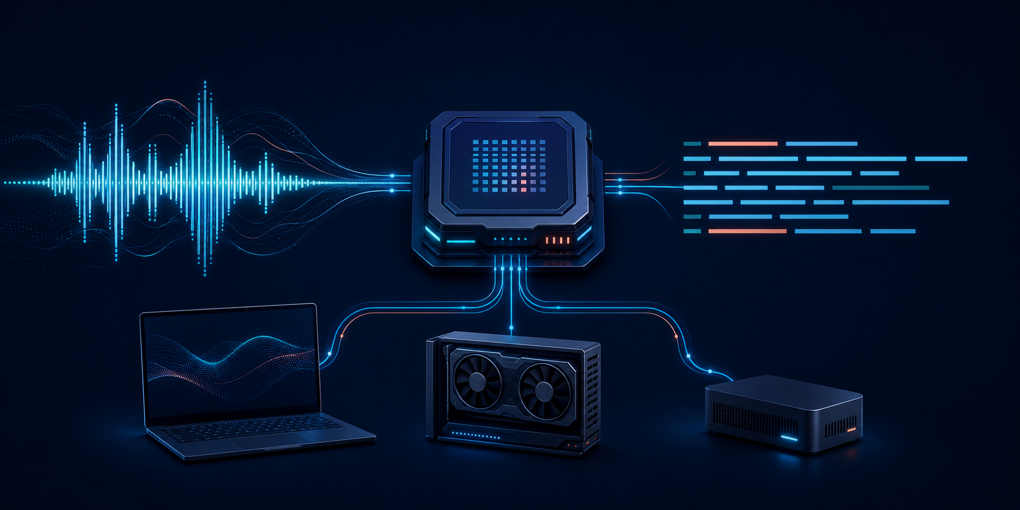
That is the problem transcribe.cpp tries to solve. It is a C/C++ inference library built on ggml, with one public interface over a wide range of speech-to-text architectures. Its first release supports streaming and batch transcription, GPU acceleration through Metal, Vulkan, and CUDA, a CPU path, GGUF model files, and maintained bindings for Python, JavaScript/TypeScript, Rust, and Swift/Objective-C.
The useful idea is not merely “speech recognition in C++.” It is that model support, hardware acceleration, numerical correctness, and application distribution should be treated as one engineering problem.
The Model Was Never The Whole Product
CJ Pais started transcribe.cpp while maintaining Handy, an open-source dictation application. Handy listens while a keyboard shortcut is held, transcribes locally, and inserts the result into the active text field. It sounds like one small feature. Underneath, it has to record audio, manage model downloads, choose the right inference backend, handle multiple operating systems, package native dependencies, and remain responsive on machines with very different processors.
Whisper.cpp already provides a strong, portable implementation of OpenAI’s Whisper family. But speech recognition has moved beyond one architecture. Parakeet, Canary, Moonshine, Qwen3-ASR, Granite Speech, Voxtral, SenseVoice, Nemotron, and other families make different trade-offs around latency, languages, model size, streaming, translation, and domain specialization.
Adding one of those models to an application through its reference implementation is straightforward enough. Supporting ten of them is a multiplication problem:
- The model may require a large Python environment that is awkward to embed.
- Acceleration may exist only for NVIDIA CUDA or only for Apple hardware.
- An ONNX export may be available, but its origin and numerical fidelity may be unclear.
- Preprocessing and decoding logic may live outside the exported graph.
- A mobile or desktop application needs a stable native API and predictable model files.
- Every new engine creates another build, release, and support path.
This is why local AI often looks better in a notebook than in a downloadable product. Model quality is visible, while distribution complexity is hidden.
One Runtime, Many Architectures
Transcribe.cpp puts the common tensor work on ggml, the same low-level machine-learning library that helped make llama.cpp and whisper.cpp practical. Model weights are distributed as GGUF files, and the runtime maps their computation onto the available backend.
The project currently advertises 16 model families and more than 60 variants. That count includes familiar encoder-decoder systems such as Whisper, streaming transducers, CTC models, and audio-language models. Supporting them does not mean pretending every architecture is identical. Each family still needs its own feature extraction, graph construction, state handling, and decoder. The shared layer is the runtime, file format, hardware abstraction, build system, and public API around those implementations.
This separation is important. A universal interface is useful only if it preserves the capabilities that distinguish the models. Batch transcription can process a completed recording with full context. Streaming transcription must retain state across audio chunks and produce partial results with low latency. A multilingual audio-language model may also translate or follow a prompt. A medical model may be accurate in one narrow domain but inappropriate elsewhere.
Transcribe.cpp supplies a common place for those differences rather than forcing every application developer to rediscover them.
Portable Acceleration Is The Main Event
CPU inference is a valuable fallback, but local AI becomes much more compelling when it uses hardware already in the machine. The catch is that “the GPU” is not one target.
On Apple silicon, Metal is the natural path. NVIDIA systems favor CUDA. Vulkan offers a cross-vendor route across many AMD, Intel, NVIDIA, Qualcomm, and ARM devices on Linux, Windows, and Android. Transcribe.cpp exposes all three, plus a tinyBLAS-accelerated CPU path. Its documentation says Metal is enabled automatically on Apple silicon; Vulkan and CUDA can be selected at build time.
Ggml makes this manageable by representing model work as a computation graph and scheduling supported operations on a backend. The Vulkan scheduler, for example, can place supported graph nodes on the GPU while falling back to the CPU for operations that do not have a Vulkan implementation. That is more realistic than requiring every backend to achieve perfect feature parity before it is useful.
Portability still has a cost. A graph that runs correctly on one backend may expose numerical, synchronization, memory, or kernel-coverage problems on another. Performance also includes more than the neural network. The host-side decoder can become the bottleneck after GPU acceleration makes the encoder fast. Transcribe.cpp recommends OpenBLAS for that path and reports a roughly 10–15x decoder speedup over its scalar fallback.
The broader lesson is easy to miss: accelerating the biggest matrix multiplications is not the same as accelerating the application. Audio conversion, feature extraction, memory transfers, decoding, and output handling all sit on the critical path.
Correctness Needs Two Kinds Of Tests
Porting a model is not finished when it produces plausible words.
Speech recognizers are unusually good at hiding implementation mistakes. A wrong normalization constant, padding rule, positional offset, vocabulary mapping, or decoder transition may still yield readable text. Testing a few clean recordings by ear can make a broken port look complete.
Transcribe.cpp addresses this at two levels. First, it numerically compares intermediate and final tensors against the reference implementation. This is the close-up test: given the same input, does the port perform the same computation within an expected tolerance?
Second, it runs word error rate sweeps over thousands of utterances. Word error rate counts substitutions, deletions, and insertions relative to a reference transcript, divided by the number of reference words. This is the end-to-end test: even if floating-point values are not bit-for-bit identical, does the system produce equivalent language output across a real corpus?
The project publishes the models it supports through the Handy organization on Hugging Face and says each has been numerically verified and WER-tested against its source implementation. That does not prove a model is universally accurate. A benchmark corpus may not represent a user’s accent, language, microphone, background noise, or vocabulary. It does provide evidence for a narrower and crucial claim: the port did not quietly make the original model worse.
These two checks belong together. Tensor comparisons localize implementation errors, while WER testing catches changes that matter to users. A production inference port needs both internal equivalence and external behavior.
GGUF Turns A Model Into A Shippable Artifact
Reference checkpoints are often optimized for researchers who will load them through the original framework. Applications need something more stable: a model file with weights, metadata, architecture information, and a predictable loader.
Transcribe.cpp distributes prebuilt GGUF files for supported variants. It also includes conversion tools for source checkpoints and a quantizer with formats ranging from F16 through Q8, Q6, Q5, and Q4 presets.
Quantization reduces the precision used to store and calculate with weights. Smaller files download faster, consume less memory, and can run on more devices. The trade-off is potential accuracy loss and backend-specific performance behavior. There is no universally best quantization; application developers must balance model size, speed, memory, and WER on representative audio.
A canonical model artifact has another benefit: it makes a bug reproducible. “This model from this repository, loaded through this Python environment” leaves room for dependency drift and conversion differences. A specific GGUF plus a runtime version is a much tighter unit for testing and support.
The API Is Designed To Leave The Demo
The core library exposes a single C header, while official bindings target four application ecosystems:
- Python for scripts, evaluation, and existing machine-learning workflows.
- TypeScript and JavaScript for desktop and server applications in that ecosystem.
- Rust, which Handy itself uses.
- Swift and Objective-C for native Apple software.
Maintaining those bindings beside the library matters. Community bindings are valuable, but an application team needs to know that API changes, memory ownership, callbacks, and streaming state will be updated together. A binding that compiles once and then drifts is another abandoned integration path.
The command-line experience is deliberately small: build with CMake, download a model, and pass a 16 kHz mono WAV file to transcribe-cli. Real applications will need more. They must resample live audio, manage devices, buffer streaming chunks, download and verify model files, expose progress and cancellation, handle unavailable backends, and package native libraries for every target.
Transcribe.cpp removes the model-specific inference engines from that list. It does not remove application engineering.
Privacy Is A Property Of The Whole Path
On-device transcription has an obvious privacy advantage: raw speech can remain on hardware the user controls. Handy makes this the center of its promise. Local execution also works without an internet connection, avoids per-minute API charges, and can reduce network latency.
But “uses a local model” is not by itself a privacy guarantee. The application may retain recordings, sync transcript history, send crash reports, fetch remote corrections, or pass the text into another cloud service. Operating-system permissions, model-download integrity, log files, and temporary audio all matter.
The runtime gives developers the option to keep inference local. The finished product must preserve that boundary intentionally and explain it accurately.
What Version 0.1 Does Not Promise
The project’s author calls the first release rough around the edges, and that is the right framing. A broad compatibility table creates a substantial maintenance obligation. New upstream checkpoints appear, model architectures evolve, ggml changes, GPU drivers regress, and users combine operating systems and hardware that a small project cannot test exhaustively.
There are also product-level questions outside a general inference runtime:
- Speaker diarization is model-dependent, not a universal feature.
- Voice activity detection and turn-taking policy shape streaming usability.
- Punctuation, timestamps, translation, and language detection differ by family.
- Real-time performance depends on the exact model, quantization, backend, and device.
- A model’s license and training terms may constrain redistribution even when the runtime is MIT-licensed.
- Accuracy claims need evaluation on the target population and acoustic environment.
The library is therefore best understood as promising a coherent integration surface, not identical behavior from every model on every machine.
A Better Abstraction For Local AI
Cloud speech APIs became popular partly because they collapse a messy stack into one request. Send audio to an endpoint and receive text. The provider owns accelerators, model deployment, versioning, and scaling.
Local inference needs an equivalent abstraction, but it cannot hide the user’s hardware. It has to turn heterogeneity into a manageable set of choices: model, quantization, backend, and a stable API. It also needs evidence that a portable port remains faithful to the reference.
Transcribe.cpp is interesting because it treats all of that plumbing as the product. The project grew from an application maintainer’s practical pain, not from a desire to publish one more speech model. Its success will depend less on a headline benchmark than on whether new model families can be added, tested, packaged, accelerated, and upgraded without making downstream applications absorb the churn.
That is the missing layer in much of local AI. Capable models already exist. The scarce work is turning them into dependable software that people can install.
Sources
- CJ Pais’ transcribe.cpp introduction
- transcribe.cpp source, model matrix, build instructions, and bindings
- Mozilla.ai announcement and Builders in Residence context
- Handy local speech-to-text application
- Handy model collection and validation notes on Hugging Face
- ggml Vulkan backend documentation
- Hacker News discussion